
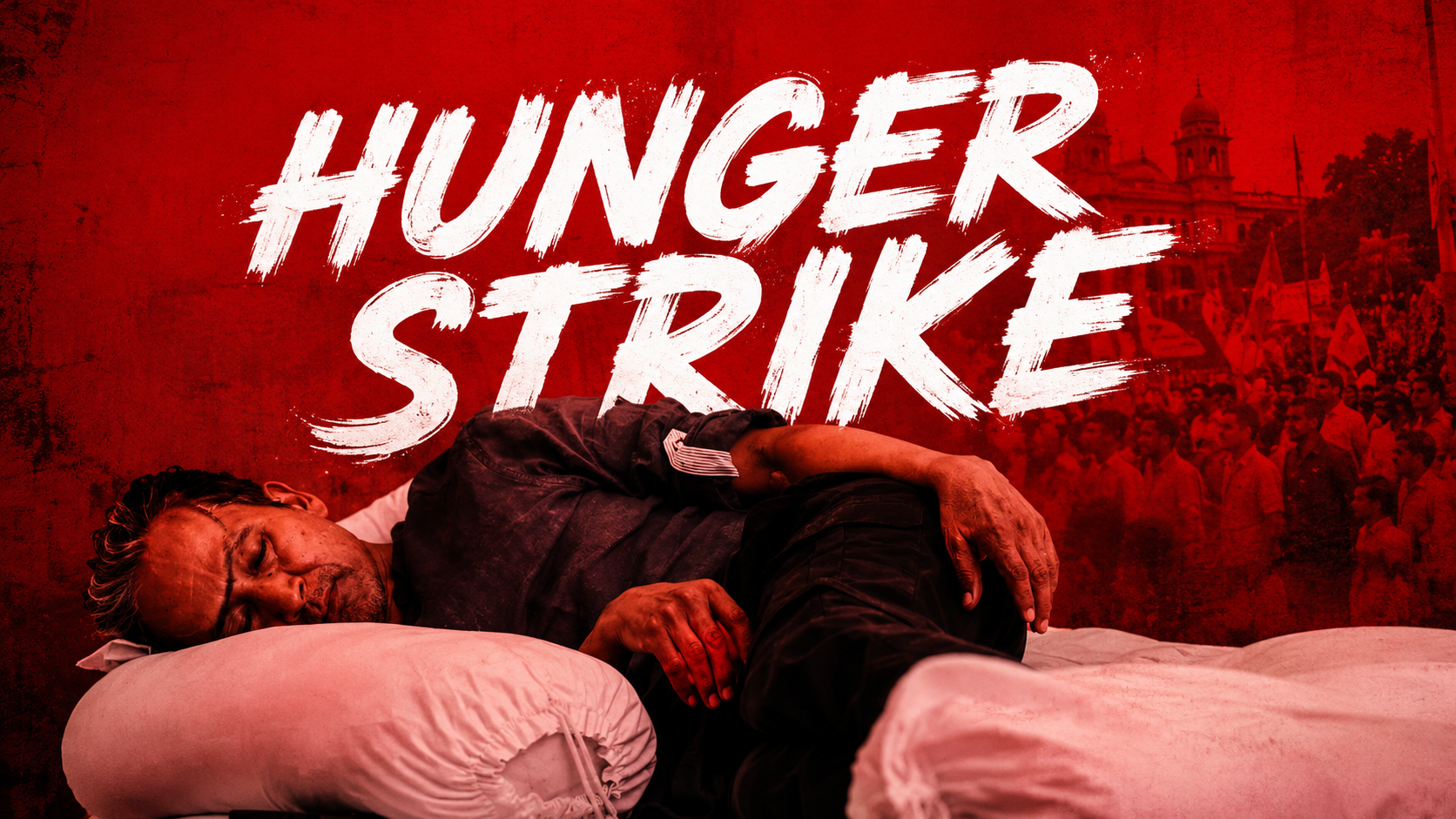
On July 16, 2026, Sonam Wangchuk — engineer, education reformer, environmental activist, and the man who inspired Phunsuk Wangdu in 3 Idiots — lay on a stage at Delhi’s Jantar Mantar surrounded by medics. He had lost 8.9 kilograms over 18 days without food. His blood pressure stood at 105/76. Doctors watching him report that his muscle mass is now depleting rapidly.
On Tuesday, a Delhi High Court petition argued he could lose his life within two days if the fast continues. The petition urged the court to force-feed him and shift him to a government hospital immediately.
India’s government has still not responded.
Education Minister Dharmendra Pradhan has said nothing. His ministry has said nothing. The government’s chief spokesperson has said nothing. When Reuters sought comment, none of them replied.
That silence — from an administration that has governed for 12 years and prides itself on decisive action — is not accidental. It is the statement at the heart of what is happening at Jantar Mantar right now.
What Started This: The NEET Paper Leak
To understand why Wangchuk is fasting in Delhi, it helps to go back to May 2026 and what happened to millions of Indian students.
The NEET-UG examination — the national entrance test for undergraduate medical admissions taken by millions after years of preparation — suffered a serious paper leak. Questions and answers circulated before the exam date. As a result, students who had spent years and enormous financial resources preparing for a single shot at a medical seat found themselves competing on a fundamentally compromised playing field.
The fallout proved severe. Families of students who died by suicide following the irregularities entered the public conversation. Consequently, the Jantar Mantar protest now demands not just Pradhan’s resignation but also Rs 1 crore in compensation for families of students who took their own lives in the aftermath.
This demand sits at the intersection of educational failure, administrative accountability, and the specific cruelty of a system that gives young people one high-stakes shot at their futures — and then compromises it.
Enter the Cockroach Janta Party
The protest is led by an organisation whose name sounds satirical but whose impact is anything but — the Cockroach Janta Party, or CJP.
Abhijeet Dipke, a 30-year-old activist, founded the CJP in May 2026. The party describes itself as representing “the lazy, the unemployed, and the chronically correct.” Within days of launch, its Instagram account gained 22 million followers — a pace that reflects the depth of frustration among young Indians with the existing political system. The name is a deliberate provocation: cockroaches survive everything, and unlike more polished political outfits, the CJP makes no pretence of palatability.
For 25 consecutive days, the CJP has staged a sit-in at Jantar Mantar, demanding Pradhan’s resignation over NEET. Furthermore, the group has planned a march to Parliament on July 20 — the opening day of the Monsoon Session. Wangchuk has said this march is his reason for continuing the fast despite his deteriorating condition. He will not stop until the government agrees to talk.
“Sonam sir is asking us to keep preparing for the march to Parliament on July 20,” Dipke told onlookers and YouTubers at the protest site on Tuesday. “I feel the government wants Sonam sir and other people on hunger strike to die.”
Meanwhile, a young person who was also fasting at the site fainted on Monday and required hospitalisation.
Why Wangchuk Joined
Wangchuk arrived at Jantar Mantar on June 28 and began fasting in solidarity with Dipke and the CJP. His presence immediately transformed what was a significant but niche Gen Z protest into a national story.
His credibility is moral and practical rather than political. As the founding director of the Students’ Educational and Cultural Movement of Ladakh (SECMOL) — which he established in 1988 to reform Himalayan education — Wangchuk built his reputation through results, not rhetoric. He also pioneered the Ice Stupa project, creating artificial glaciers that store winter water for summer use in high-altitude desert regions. Additionally, his life inspired the Aamir Khan character in one of Bollywood’s most beloved films.
Beyond his achievements, however, his recent history adds another layer of significance to his presence at Jantar Mantar. Between September 2025 and March 2026, authorities detained him under the National Security Act for six months following protests in Ladakh over demands for full statehood and inclusion under the Sixth Schedule of the Constitution. Officials held him without formal charge. The Supreme Court’s questions about the legality of his detention ultimately prompted his release.
That history carries enormous weight. A man jailed under the NSA for demanding constitutional rights, freed after six months, and now fasting in solidarity with students whose exam was compromised — Wangchuk’s presence at Jantar Mantar holds a moral authority that no purely political figure could replicate.
The Opposition Responds — Gently
Several senior opposition leaders have visited Wangchuk or posted messages in solidarity. Notably, however, most are urging him to end the fast rather than escalating pressure on the government.
Samajwadi Party chief Akhilesh Yadav appealed to him through X, calling his life “invaluable to the entire world.” Arvind Kejriwal announced he would visit Jantar Mantar on July 16 and asked Wangchuk to end his hunger strike, calling him “the country’s heritage.”
The framing reveals something important. The opposition’s core message to Wangchuk is: you are too important to risk your life. Yet the implicit corollary — that they are unwilling to mount sustained political pressure to make the government respond — remains unspoken.
In contrast, the entertainment world has responded more directly. Actor Swara Bhaskar visited Jantar Mantar in person. Television actor Rubina Dilaik called Wangchuk a “real hero.” Most pointedly, Omi Vaidya — who played Chatur in 3 Idiots — posted on Instagram: “I don’t want Funsukh Wangdu to die. Right now he is on a very long hunger strike. His blood sugar has gone down very much. I don’t know if the media is reporting this. But this is a pretty important thing.”
He is right about inconsistent media coverage. Outlets have reported the story, but it has not received the sustained front-page, prime-time treatment that the combination of Wangchuk’s condition, the NEET crisis’s scale, and the government’s silence arguably warrants.
What the Government’s Silence Actually Means
Pradhan has not resigned. He has not visited Jantar Mantar. Moreover, he has not issued a single statement about Wangchuk’s worsening condition.
This is not an oversight — it is a deliberate strategic calculation worth analysing openly.
The Modi government’s standard response to protest movements it does not wish to engage with involves waiting them out, limiting media oxygen, and avoiding any optics of negotiation under pressure. This approach succeeded with several protests over the past decade. The underlying calculation holds that engagement legitimises the protest and sets a precedent for future demands.
However, applying that calculation to Wangchuk’s situation creates a serious problem. A man losing nearly a kilogram per day, with a Delhi High Court petition arguing he could die within 48 hours, cannot simply be waited out without political, moral, and legal consequences mounting daily.
Additionally, the Parliament march on July 20 adds pressure the government cannot easily manage. If Wangchuk is still fasting that day, images of a visibly deteriorated activist marching toward the opening of the Monsoon Session will define the day’s narrative in ways the administration cannot control.
The NEET Crisis Is Bigger Than One Exam
It is worth stepping back from the immediate drama to acknowledge the deeper issue that brought Wangchuk to Jantar Mantar.
India’s high-stakes entrance examination system — NEET for medicine, JEE for engineering — has faced criticism for years. Critics point to the extraordinary pressure it places on young people, the vast coaching industry it has spawned, and the way a single exam on a single day determines a student’s entire trajectory. When a paper leak compromises that system, the damage extends well beyond the cheated candidates. It destroys trust in the system itself.
Students who spent lakhs on coaching, sacrificed years of adolescence in preparation, and relocated to other cities for better coaching centres are not simply angry about one bad exam. Rather, they are furious at a system that demanded everything from them and then failed to protect the integrity of the moment that was supposed to justify all of it.
That anger is what the CJP has channelled. Furthermore, that anger is what brought Wangchuk to Jantar Mantar on June 28. Even now, on day 18, that anger keeps him there despite losing nearly nine kilograms and requiring round-the-clock medical supervision.
Our Take: The Government Needs to Respond — Now
ObserverFile rarely uses this space to make a direct call on a breaking situation. This is one of the exceptions.
Sonam Wangchuk is not a BJP political opponent. He holds no party affiliation. Instead, he is an engineer, environmentalist, and educator who has spent his life solving practical problems in one of India’s most marginalised regions. His demand — that a minister take responsibility for a catastrophic national examination failure affecting millions — is not unreasonable.
The government’s continued silence while a respected public figure’s health deteriorates is not a display of strength. Rather, it is a display of indifference without justification.
Pradhan should respond. The Prime Minister’s Office should respond. If a factual dispute exists about what happened and who bears responsibility, make that case publicly. If corrective actions are already underway, announce them. However, staying silent while a nationally respected figure fasts toward critical condition over a legitimate public grievance projects callousness, not authority.
The march to Parliament is four days away. India’s lawmakers will arrive to open the Monsoon Session while a 59-year-old activist who was jailed under the NSA for demanding constitutional rights lies nearby having eaten nothing for 22 days.
Whatever one thinks of hunger strikes as political tactics, the government holds the power to resolve this without conceding anything unreasonable. So far, it has chosen not to use that power.
That choice carries consequences — political, moral, and possibly medical — that no amount of media management will paper over.
For more on national politics and governance accountability, follow ObserverFile — News Beyond the Noise.