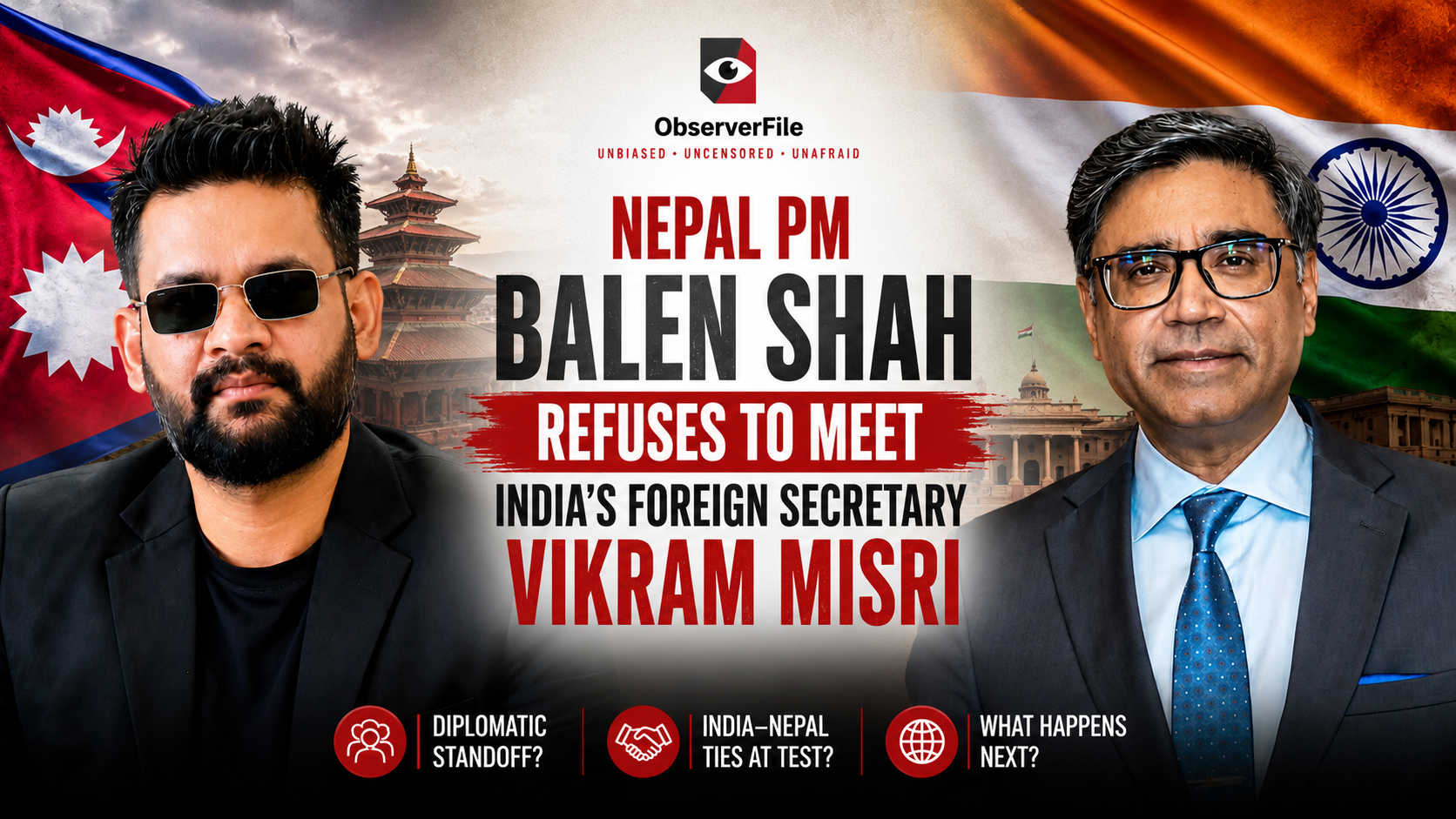
A fresh diplomatic controversy has emerged between India and Nepal after Nepal Prime Minister Balen Shah reportedly declined to meet Indian Foreign Secretary Vikram Misri during his planned visit to Kathmandu.
The issue has triggered intense political and diplomatic discussions across South Asia, with critics calling it an unnecessary diplomatic escalation while supporters of Balen Shah argue that Nepal is attempting to establish a more institution-driven foreign policy.
The controversy reportedly contributed to the postponement of Vikram Misri’s scheduled Kathmandu visit, which was expected to focus on bilateral relations, regional diplomacy, and high-level political engagement between India and Nepal.
Why Vikram Misri’s Nepal Visit Was Important
Indian Foreign Secretary Vikram Misri was scheduled to visit Nepal for a two-day diplomatic engagement beginning on May 11.
According to multiple reports, the visit was expected to include:
- discussions on India-Nepal bilateral ties,
- meetings with Nepal’s new political leadership,
- future strategic cooperation,
- and possible high-level exchanges between the two countries.
The visit came at a politically sensitive moment, as Nepal’s newly elected Prime Minister Balen Shah has been attempting to reshape the country’s political and diplomatic image after his landslide electoral victory earlier this year.
Why Did Balen Shah Refuse the Meeting?
Reports from Nepali media suggest that Prime Minister Balen Shah was unwilling to meet Vikram Misri because he believed discussions should happen between officials of “equal stature.”
According to sources cited in Nepali publications:
- Shah preferred engagement at the prime ministerial level,
- or through a more equivalent diplomatic channel,
- rather than directly meeting a foreign secretary-level official.
Although neither India nor Nepal officially framed the issue as a diplomatic standoff, the refusal quickly became a major topic in political circles and on social media.
Nepal’s New Diplomatic Approach Under Balen Shah
Since becoming Prime Minister, Balen Shah has attempted to establish a different diplomatic style compared to previous Nepali governments.
Limiting Informal Diplomatic Access
According to reports from Nepal, Shah has:
- reduced informal access for foreign diplomats,
- avoided several traditional diplomatic interactions,
- and emphasized institutional rather than personality-driven diplomacy.
Supporters argue that previous Nepali governments often allowed excessive informal influence from foreign powers, particularly neighboring countries.
Some Nepali commentators believe Shah is trying to:
- reinforce Nepal’s sovereignty,
- reduce dependence on personality-based diplomacy,
- and project stronger national self-respect internationally.
Earlier Refusals to Meet Foreign Officials
This is reportedly not the first instance where Balen Shah declined meetings with visiting foreign representatives.
Reports indicate that Shah had previously not met:
- US Special Envoy Sergio Gor,
- and other visiting diplomatic representatives.
These decisions have created debate within Nepal itself.
Some political observers praise the move as a sign of assertive diplomacy, while others believe it risks isolating Nepal diplomatically.
The Lipulekh Issue and India-Nepal Tensions
The controversy surrounding Vikram Misri’s postponed visit also comes amid renewed tensions over the Lipulekh Pass issue.
Why Lipulekh Is Sensitive
Nepal has objected to India reopening applications for the Kailash Mansarovar Yatra route through Lipulekh, an area Nepal claims as disputed territory.
The territorial issue has historically remained one of the most sensitive disputes between India and Nepal.
Political analysts believe the timing of the controversy likely intensified diplomatic discomfort on both sides.
Who Is Balen Shah?
Balen Shah is one of South Asia’s most unconventional political leaders.
Before entering mainstream politics, he was known as:
- a rapper,
- engineer,
- activist figure,
- and later as Kathmandu’s mayor.
In 2026, his political movement achieved a historic electoral victory in Nepal, propelling him to the office of Prime Minister.
His rise reflected growing public frustration in Nepal against:
- traditional political parties,
- corruption,
- and unstable coalition politics.
Critics Say the Move Was Diplomatically Risky
Many diplomatic observers believe refusing to meet India’s Foreign Secretary could create unnecessary friction in India-Nepal relations.
Why India-Nepal Relations Matter
India remains:
- Nepal’s largest economic partner,
- a critical transit route,
- a major energy and trade partner,
- and deeply interconnected socially and culturally with Nepal.
Critics argue that symbolic diplomatic gestures matter significantly in South Asian geopolitics.
Some experts fear that:
- perceived diplomatic coldness,
- public disagreements,
- and symbolic protocol disputes
could affect future bilateral coordination.
Supporters Say Nepal Is Asserting Sovereignty
At the same time, many supporters of Balen Shah argue the move reflects a stronger and more independent Nepal.
On Nepali social media platforms, several users praised Shah for:
- treating Nepal as an equal sovereign state,
- avoiding diplomatic hierarchy,
- and resisting traditional regional pressure dynamics.
Some supporters also argue that Nepal has historically been too dependent on India diplomatically and economically.
Reactions on Indian Social Media
The controversy has also triggered strong reactions in India.
Several online discussions criticized Balen Shah’s decision, with some users calling it:
- immature diplomacy,
- symbolic posturing,
- or unnecessary ego politics.
However, some commentators also noted that smaller neighboring countries often attempt symbolic diplomatic assertions to project domestic political strength.
Diplomatic Optics Matter in South Asia
In South Asian politics, symbolism often carries enormous political weight.
Even small diplomatic protocol decisions can:
- influence public perception,
- shape media narratives,
- and affect bilateral political atmospheres.
The controversy surrounding Vikram Misri’s postponed visit is therefore being viewed not only as a scheduling issue, but also as a reflection of evolving regional political dynamics.
Is Balen Shah Trying to Redefine Nepal’s Foreign Policy?
Some analysts believe Balen Shah is attempting to redefine Nepal’s diplomatic culture.
A Shift Away From Traditional Political Practices
Unlike traditional Nepali leaders, Shah has:
- avoided frequent diplomatic meetings,
- reduced public appearances,
- and maintained a relatively controlled communication style.
Supporters view this as disciplined governance.
Critics argue it may create diplomatic confusion and communication gaps.
What Happens Next?
Despite the controversy, most experts believe India and Nepal are unlikely to allow the issue to escalate significantly.
The relationship between the two countries remains strategically too important for long-term diplomatic disruption.
However, the episode may:
- influence future diplomatic engagements,
- reshape protocol expectations,
- and affect perceptions surrounding Balen Shah’s leadership style internationally.
Conclusion
The postponement of Indian Foreign Secretary Vikram Misri’s Nepal visit after Prime Minister Balen Shah reportedly refused a meeting has sparked a wider debate about diplomacy, protocol, sovereignty, and regional politics.
For supporters, Shah’s decision represents a more assertive and self-respecting Nepal.
For critics, it risks creating unnecessary diplomatic tensions with India at a sensitive geopolitical moment.
Whether the move reflects strategic diplomatic recalibration or symbolic political messaging, the incident has already become one of the first major foreign policy controversies of Balen Shah’s premiership.