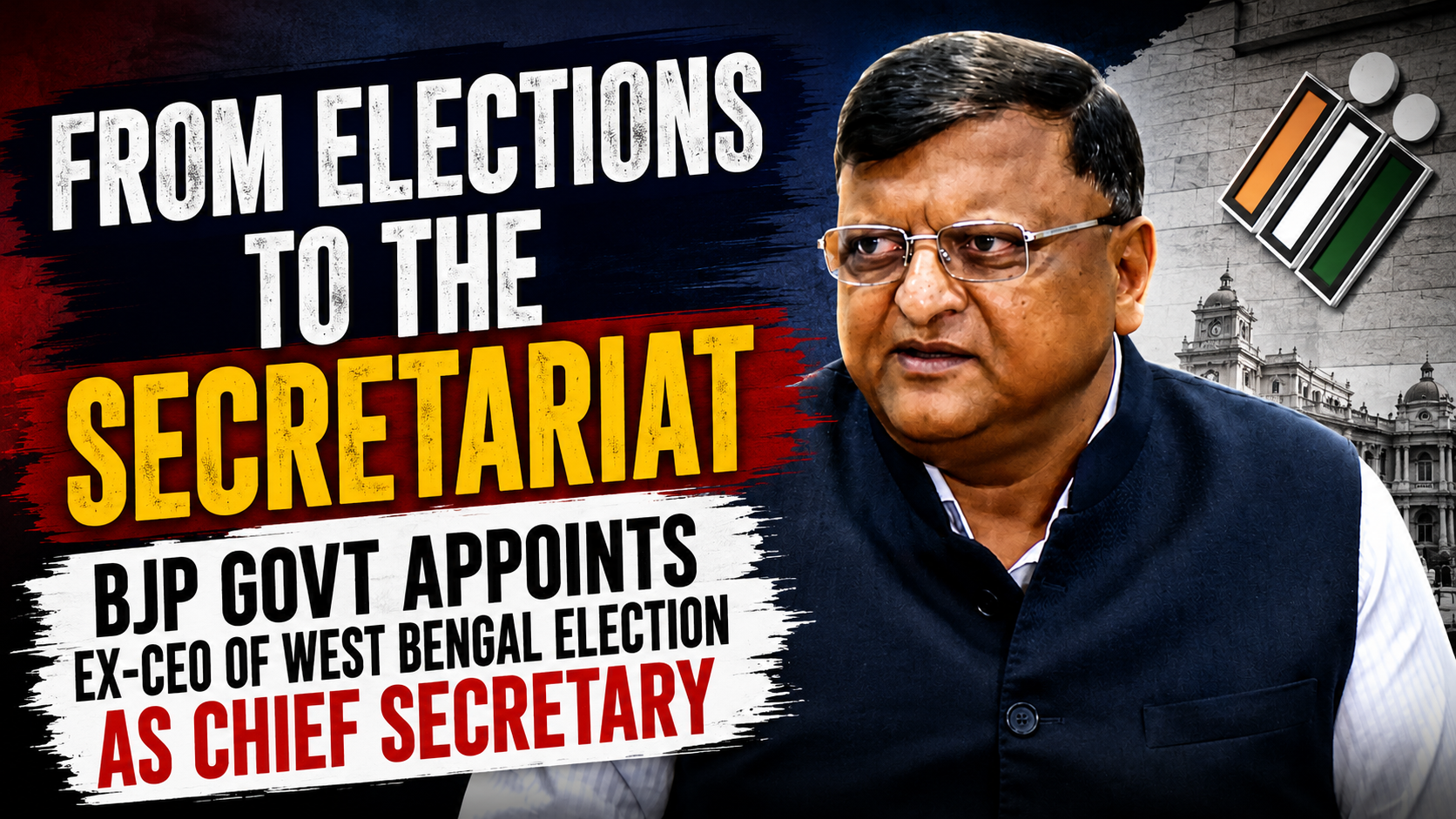
The appointment of former West Bengal Chief Electoral Officer Manoj Kumar Aggarwal as the new Chief Secretary of West Bengal by the newly formed BJP government has triggered a massive political controversy across the state.
For the BJP, the appointment is being projected as a bureaucratic reshuffle based on administrative experience and governance requirements.
But for the Trinamool Congress (TMC) and several opposition voices, the development has intensified allegations that the 2026 West Bengal Assembly election was heavily influenced by the Election Commission of India (ECI).
The controversy has become even sharper because Manoj Aggarwal played a key role in conducting the very election that brought the BJP to power in Bengal.
Why the Appointment Became So Controversial
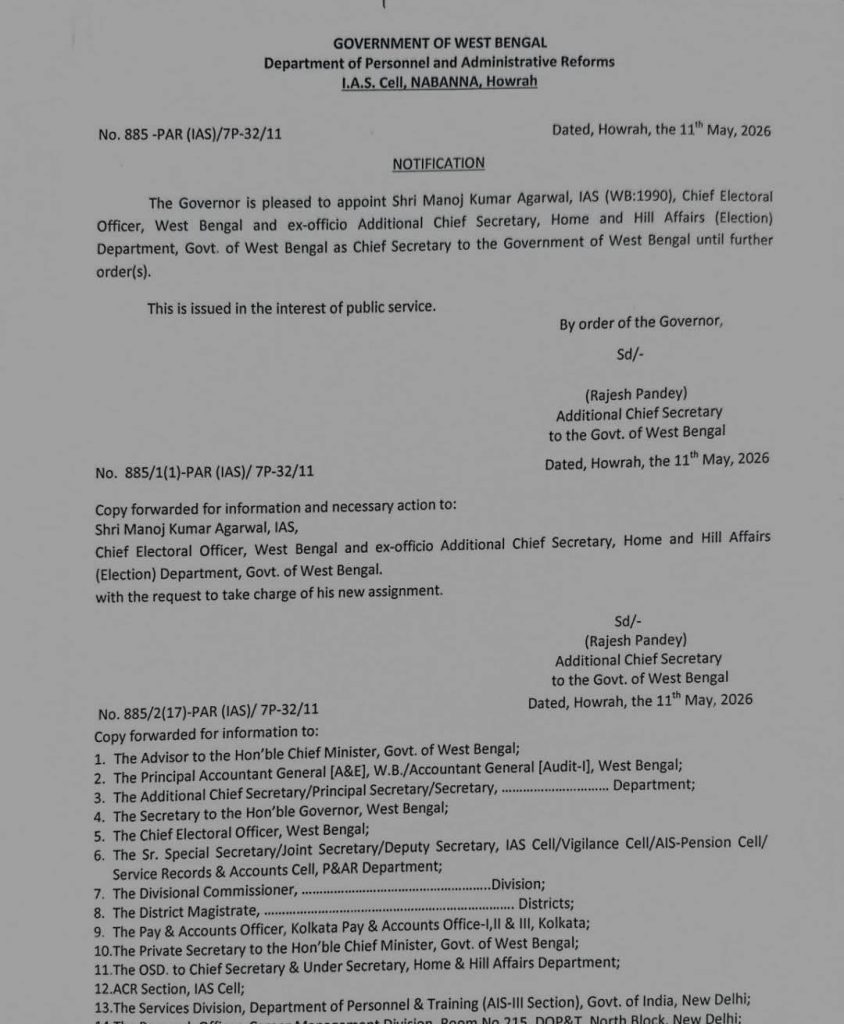
On May 11, the newly elected BJP-led Bengal government appointed Manoj Kumar Aggarwal as the state’s Chief Secretary.
Aggarwal had earlier served as:
- Chief Electoral Officer (CEO) of West Bengal,
- and was one of the key bureaucratic faces overseeing the 2026 Assembly elections.
The timing of the appointment immediately triggered political reactions because:
- the election itself remains highly controversial,
- the TMC continues alleging manipulation by the Election Commission,
- and multiple opposition parties have questioned the neutrality of election management in Bengal.
Critics argue that appointing a top election official immediately after a regime change creates damaging political optics.
TMC’s Allegation: “Open Reward for Election Management”
Several opposition leaders and political commentators have claimed the appointment appears like a “reward posting” for conducting the election in a manner allegedly favorable to the BJP.
On social media, many users accused the BJP and ECI of no longer “even trying to hide” their closeness.
The appointment has especially fueled suspicions because:
- the election was already surrounded by controversy regarding SIR voter revisions,
- deployment of central forces,
- removal of state bureaucrats,
- and the role of central agencies.
For TMC supporters, Aggarwal’s appointment is now being cited as further evidence supporting their long-standing allegations about institutional bias.
The Election Commission’s Earlier Bureaucratic Reshuffle
The controversy cannot be understood without looking at the events leading up to the election.
Removal of Bengal’s Top Bureaucrats Before Polls
Immediately after the West Bengal election schedule was announced, the Election Commission removed several senior state officials, including:
- Chief Secretary Nandini Chakravorty,
- Home Secretary Jagdish Prasad Meena,
- and multiple police officials.
The ECI said these changes were necessary to ensure free and fair elections.
However, the TMC strongly criticized the move, claiming:
- the Commission was interfering excessively in state administration,
- and weakening the elected state government before polls.
Rise of Manoj Aggarwal During Election Administration
Following these reshuffles, election management increasingly came under officials perceived to be closer to the Election Commission’s central administrative structure.
As CEO of Bengal, Manoj Aggarwal became one of the most influential bureaucrats during the election process.
This included oversight of:
- polling management,
- administrative coordination,
- election logistics,
- and voter roll implementation mechanisms.
Why Optics Matter in Elections
Even if no direct evidence of wrongdoing exists, political analysts argue that the optics of such appointments matter enormously in a democracy.
Perception of Institutional Neutrality
The Election Commission is expected to remain politically neutral.
When senior election officials later receive important administrative positions under governments that benefited electorally from the same election, critics argue that:
- public trust can erode,
- suspicions increase,
- and institutional credibility suffers.
This debate has become especially sensitive in India because opposition parties across several states have increasingly questioned the neutrality of constitutional institutions.
Similar Debate Around Subrata Gupta
Manoj Aggarwal’s appointment is not the only controversy.
Another major debate erupted after retired IAS officer Subrata Gupta was appointed advisor to Chief Minister Suvendu Adhikari shortly after serving as Special Roll Observer during Bengal’s controversial SIR process.
Why Critics Raised Questions
The SIR voter revision process itself became one of the biggest political flashpoints of the election.
Opposition parties alleged:
- large-scale voter exclusion,
- demographic targeting,
- and selective scrutiny in Bengal.
When a key observer linked to that process later joined the new BJP administration, critics argued that it deepened public suspicion.
Even some neutral observers stated that:
“Optics matter enormously in elections.”
BJP’s Counterargument
The BJP has rejected all allegations surrounding the appointment.
Supporters argue that:
- senior IAS officers frequently continue serving under different governments,
- administrative appointments after elections are routine,
- and there is no evidence proving electoral misconduct.
Many BJP supporters also point out that bureaucrats appointed under previous governments have historically continued under new administrations as well.
Some also accuse the TMC of refusing to accept electoral defeat after losing power following 15 years in office.
Mamata Banerjee’s Larger Allegation Against ECI
Since the election results, Mamata Banerjee has repeatedly accused the Election Commission of helping the BJP politically.
Following the BJP’s victory:
- Mamata alleged the election was shaped by “conspiracy,”
- questioned the fairness of the electoral process,
- and accused constitutional institutions of bias.
The TMC has especially focused on:
- SIR voter list revisions,
- deployment of central forces,
- removal of state officials,
- and exclusion of state employees from counting-related duties.
Controversy Around Central Employees During Counting
Before the election results, the TMC had already approached the Supreme Court regarding the Election Commission’s decision to use central government employees and PSU staff as counting supervisors instead of state personnel.
The party argued this move:
- reduced state oversight,
- weakened institutional balance,
- and gave the Centre greater influence over election management.
Although courts did not stop the process, the issue contributed to broader opposition suspicion surrounding the election.
Peaceful Elections or Controlled Elections?
One of the BJP’s strongest arguments is that the 2026 election was among the most peaceful elections Bengal has seen in decades.
The BJP claims:
- large deployment of central forces ensured voter confidence,
- prevented violence,
- and allowed free voting.
However, TMC supporters argue that:
- extraordinary central intervention itself became politically influential,
- and the atmosphere favored the BJP psychologically and institutionally.
This divide continues shaping political discourse after the election.
Social Media Reactions Intensify
The appointment of Manoj Aggarwal triggered explosive reactions online.
Across Reddit and political discussion forums:
- many opposition supporters called the move “proof” of institutional collusion,
- while BJP supporters dismissed the criticism as conspiracy theories.
The controversy quickly became part of a broader national debate around:
- electoral trust,
- institutional independence,
- and democratic transparency.
Is There Any Proof of Election Theft?
Despite the strong political allegations, no court or constitutional authority has officially declared the Bengal election manipulated or stolen.
At present:
- the allegations remain political claims,
- opposition suspicions,
- and public perception battles.
However, political experts note that in modern democracies, perception itself can become politically powerful.
Even without legal proof, repeated controversies surrounding institutions can weaken public trust in the democratic process.
The Bigger Question: Trust in Democratic Institutions
The Manoj Aggarwal controversy is now larger than a single appointment.
It reflects a deeper national debate around:
- the independence of constitutional bodies,
- post-election bureaucratic appointments,
- and the relationship between governments and institutions.
In highly polarized political environments, even routine administrative decisions can become symbols of larger ideological battles.
Conclusion
The appointment of former Bengal CEO Manoj Aggarwal as Chief Secretary by the new BJP government has intensified political tensions in West Bengal at a time when the legitimacy of the 2026 election itself remains heavily debated.
For the BJP, the appointment is an administrative decision based on experience and governance needs.
For the TMC and many opposition supporters, it reinforces suspicions that the Election Commission and BJP functioned too closely during one of Bengal’s most consequential elections.
Whether the controversy fades as routine bureaucracy or evolves into a larger national debate about electoral trust and institutional neutrality may depend on future political developments — and how the new Bengal government handles its relationship with democratic institutions going forward.