It began with a trunk call.
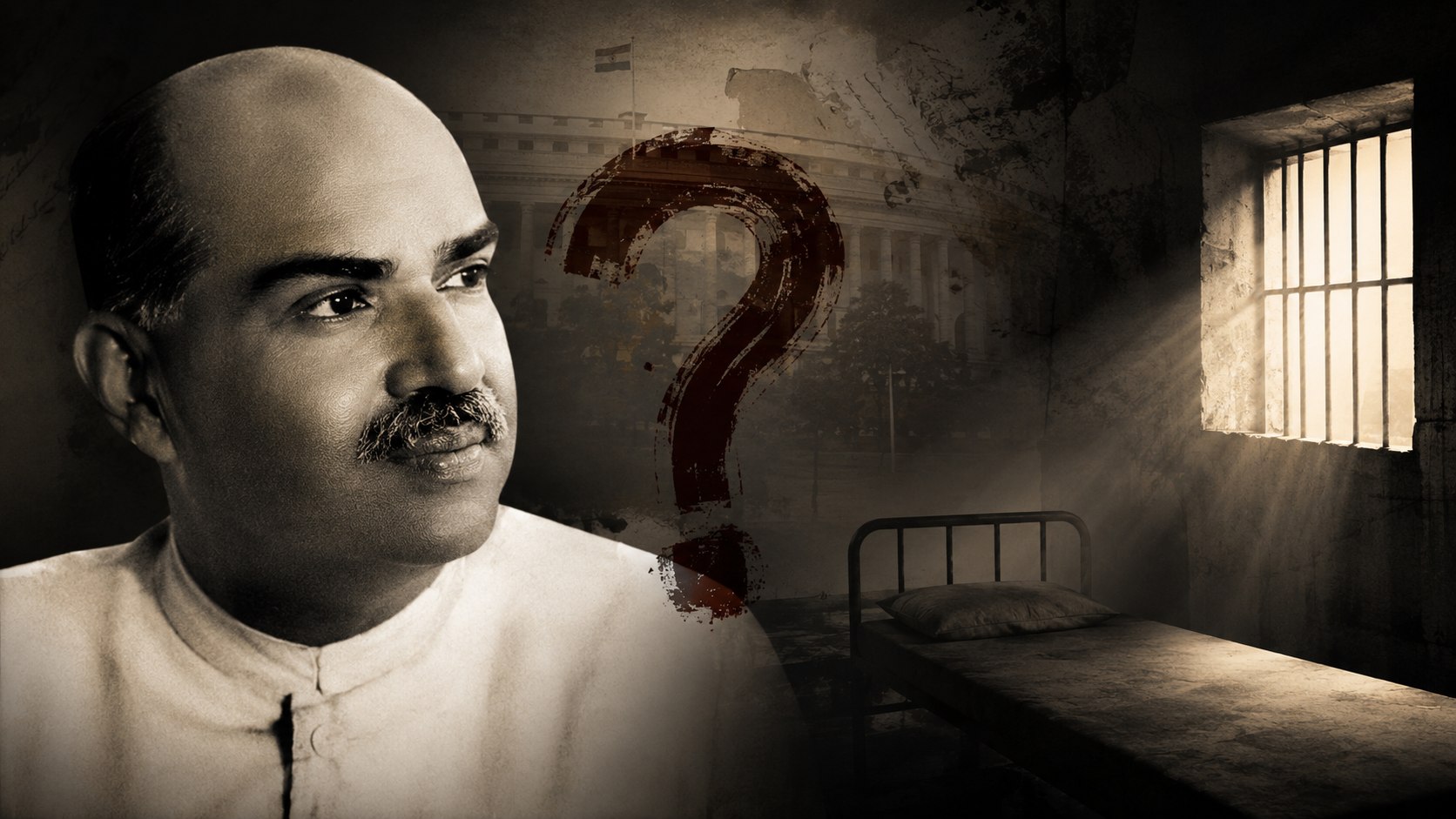
On the morning of June 23, 1953, a message crackled through telephone lines from Srinagar to Calcutta. The operator’s voice was barely audible, but the words were devastating. Dr. Syama Prasad Mookerjee was dead. His brother, Justice Rama Prasad Mookerjee, received the news at the other end. Their mother, Jogmaya Devi, had stepped away from her prayers moments earlier — convinced, perhaps hoping, that her son was finally calling from jail to say he was free.
He wasn’t calling. He was gone.
What followed was not just grief. It was a cascade of questions that no government — not Nehru’s, not those that came after, arguably not even the BJP governments that claimed his legacy — has ever properly answered.
Who Was Syama Prasad Mookerjee?
Before the mystery of his death, there’s the weight of the life he lived.
Born on July 6, 1901, into one of Bengal’s most distinguished families — his father Sir Ashutosh Mookerjee was a towering figure in Indian education — Syama Prasad had a staggering list of achievements before he turned forty. He studied at Calcutta University, became an advocate at the Calcutta High Court in 1924, went to Lincoln’s Inn in London, and returned as a barrister in 1927.
The Youngest Vice Chancellor in Calcutta University’s History
At just 33 years old, he became the Vice Chancellor of Calcutta University — the youngest in its history at the time. In 1937, he arranged for Rabindranath Tagore to deliver the convocation address in Bengali, breaking a long-standing British tradition of conducting the ceremony exclusively in English. It was a quiet, deliberate act of cultural defiance.
The Man Who Shaped West Bengal
If you live in West Bengal today, you owe something to Mookerjee — whether you agree with his politics or not. In 1947, when the question of Bengal’s partition was being debated, powerful voices — including the then Chief Minister H.S. Suhrawardy and segments of the Congress — were pushing for the entire province to merge into Pakistan. Mookerjee fought hard for the division of Bengal, ensuring that the Hindu-majority western districts remained with India. The West Bengal you know is, in no small part, the result of that fight.
Cabinet Minister Under Nehru — Then His Sharpest Critic
In the interim government of 1947, Nehru himself appointed Mookerjee as the Minister of Industry and Supply. The two men were ideologically worlds apart, yet Nehru brought him in. That alliance fractured irreparably in 1950, when Mookerjee resigned from the cabinet over the Nehru-Liaquat Pact, which he felt failed to protect Hindu minorities in East Pakistan.
By 1951, he had founded the Bharatiya Jana Sangh — the political organisation that would, decades later, evolve into the BJP. He had gone from being a minister in Nehru’s cabinet to being his most formidable parliamentary opponent.
The Kashmir Question: Why He Went
To understand Mookerjee’s death, you have to understand what took him to Kashmir in the first place.
Article 370 and a Country Divided Against Itself
When Jammu & Kashmir acceded to India in 1947, Article 370 was inserted into the Constitution as a temporary provision granting the state special autonomous status. In practice, this meant Kashmir had its own separate flag, its own Constitution, and its own Prime Minister (called the Sadr-e-Riyasat). Most strikingly, no Indian citizen — including the President of India — could enter Jammu & Kashmir without a permit issued by the Central Government. The Supreme Court of India had no jurisdiction there.
Mookerjee found this arrangement intolerable. His rallying cry became one of the most famous political slogans of independent India: “Ek desh mein do Vidhan, do Pradhan, aur do Nishan nahi chalenge” — One country cannot have two constitutions, two prime ministers, two national flags.
Sheikh Abdullah’s Crackdown
By early 1953, the situation in Jammu had become alarming. Sheikh Abdullah’s National Conference government was accused of brutal crackdowns against the Praja Parishad agitation — a movement demanding full integration of the state with India. Mookerjee received detailed telegrams from the ground describing atrocities against activists. He wrote to both Nehru and Sheikh Abdullah, demanding accountability, but got evasive responses from both.
On May 8, 1953, he sent a telegram to Sheikh Abdullah directly, making clear his intention to visit Kashmir and assess the situation himself. Abdullah neither gave permission nor explicitly forbade him from coming.
The Journey and the Arrest
Departure from Delhi
On the morning of May 8, 1953, Mookerjee left Delhi’s railway station. He was accompanied by Guru Datt Vaid, Atal Bihari Vajpayee (then a young Jana Sangh worker), Tek Chand Sharma, Balraj Madhok, and a few journalists. The compartment was decorated with flowers and Jana Sangh flags.
His position on the permit was deliberate and principled: if Nehru had repeatedly declared that Jammu & Kashmir’s accession to India was complete, then why should an Indian citizen need a foreign-style permit to enter an Indian state?
The Strangely Smooth Journey — Until It Wasn’t
Here is where things get interesting. When the group reached Pathankot, they were joined by the District Magistrate of Gurdaspur, who boarded the train and informed Mookerjee that the Central Government had no objection to him travelling further. He was, in fact, administratively accompanied right to the Kashmir border.
This detail matters enormously. If Mookerjee was genuinely violating law, why did the Central Government not stop him earlier? Why escort him to the border, only for the Kashmir Police to arrest him there?
Arrested at Lakhanpur — Without a Warrant
On May 11, 1953, as Mookerjee’s group was crossing the Ravi River at Lakhanpur on the Punjab-Kashmir border, they were stopped. He was arrested — without a warrant — by the Inspector General of Police, Jammu & Kashmir, in the presence of Maulana Masudi, General Secretary of Sheikh Abdullah’s National Conference. The charge: threatening the peace and security of Jammu & Kashmir.
Not the Central Government arresting him for defying its permit rules. The Kashmir government arresting him for disturbing their peace.
Mookerjee himself pointed out the irony. He had been given a green light by Delhi all the way to the border. The question of who was running this operation — and why — was never satisfactorily answered.
The Sub-Jail at Nishat Bagh
A Cottage on a Mountain
Mookerjee was taken on a roughly 20-hour journey to his place of detention: a small, dilapidated bungalow near Nishat Bagh, on the slopes of the mountain range flanking Dal Lake. To call it a jail is generous. To reach it, one had to climb a steep flight of stairs — already a problem for Mookerjee, who suffered from chronic leg pain.
The main room was approximately 10 feet by 11 feet. His co-detainees, Guru Datt Vaid and Tek Chand Sharma, were housed in two small side rooms. When Pandit Premnath Dogra was brought on June 19, there was no room for a fourth bed, so a tent had to be pitched outside.
Conditions His Companions Described
Mookerjee had requested somewhere to rest along the way — he mentioned that he slept early and couldn’t manage the long overnight journey. The request was ignored.
According to Guru Datt Vaid’s detailed account, conditions at the sub-jail were grim. There was no telephone. To make a call, they had to go to a Water Works Office nearby — which was only open during office hours. There was no nursing staff, no laboratory facilities for medical tests. The area was cold, damp, and infested with snakes, owls, and rats.
The official version — from the two doctors who treated him, Dr. Ali Mohammed and Dr. Amar Nath Raina — painted a very different picture: a spacious bungalow with a large garden, views of Dal Lake, and adequate facilities. Two accounts. Completely irreconcilable.
The Final Days: A Medical Account Full of Holes
June 19–20: Fever and Pain
On the night of June 19–20, Mookerjee complained of severe back pain and developed a high fever. By morning, his temperature was 99.4°F. Dr. Ali Mohammed arrived at 11:30 am and diagnosed him with dry pleurisy — a condition where the lining around the lungs becomes inflamed, often a precursor to tuberculosis or caused by exposure to cold. The doctor prescribed streptomycin injections and some powder medication.
The Streptomycin Problem
Mookerjee immediately told Dr. Mohammed that his personal physician in Calcutta, Dr. Bose, had specifically warned him against streptomycin. He was allergic to it.
Dr. Mohammed’s response: that was old advice. Medical understanding of the drug had improved. There was nothing to worry about.
That afternoon, at around 3:30 PM, he was given one gram of streptomycin. Five more powder doses were left with him.
No pathological tests were done. No blood work. No urine analysis. The prescription was not shown to Vaid.
June 21: Nobody Came
The following day, Vaid noted that no senior doctor — not Dr. Ali Mohammed — visited Mookerjee. Only the jail doctor came by and administered another gram of streptomycin. His temperature and pain increased throughout the day.
No nursing arrangement had been made. His family had not been informed, despite Mookerjee having explicitly asked the superintendent to contact them on June 20.
The Early Hours of June 22
At 4:45 am on June 22, an attendant woke Vaid urgently. He rushed to Mookerjee’s room and found him pale, weak, profusely sweating, pulse barely detectable. His body temperature had dropped to 97°F. He told Vaid he had been sweating for half an hour, felt dizzy, and feared he would lose consciousness.
Vaid gave him cardamom tea and clove water — folk remedies that, remarkably, seemed to help. Within 20 minutes, the sweating stopped, the pulse strengthened, and the chest pain began to ease.
Getting a telephone required waking someone to unlock the Water Works office. It took until 5:15–5:30 am to reach the superintendent. Dr. Ali Mohammed arrived at 7:30 am — two full hours after being summoned.
The Coramine Dispute
When Dr. Mohammed arrived and examined Mookerjee, he ordered a 2cc injection of coramine. A second doctor present — Dr. Mohammed’s associate — objected, saying 2cc was too high a dose. Dr. Mohammed overruled him, citing Mookerjee’s body weight. The higher dose was administered.
Vaid asked for permission to accompany Mookerjee to the hospital. Denied. He asked for at least one companion to be with him. Denied. Dr. Mohammed assured Vaid that Mookerjee would be “completely safe” under his care.
He was taken to the hospital in a small, four-seater car — a vehicle, as Vaid later pointedly noted, that was “entirely unsuitable for a cardiac patient.”
June 23: The Death Nobody Witnessed
At 7:30 pm on June 22, the jail superintendent telephoned Vaid to say that Mookerjee was feeling much better. That was the last update Vaid received.
At 3:45 am on June 23, the superintendent came to wake Vaid, Tek Chand Sharma, and Premnath Dogra, and told them to go to the hospital immediately. No reason was given. When they arrived at 4:30 am, Barrister Trivedi, who was already there, told them: Mookerjee had passed away about ten minutes earlier.
A nurse, when asked, said he had died at 2:30 am.
He had asked, at 1 pm on June 22, for his co-detainees to come see him at the hospital. Nobody told them. He died alone, at night, without his companions, without his family, without his own doctor.
The Questions That Were Never Answered
The Missing Diary — and the Missing Papers
Among Mookerjee’s possessions sent from Srinagar to Calcutta after his death, several items were absent. He was reportedly writing a biography of his father, Sir Ashutosh Mookerjee. Those papers were not in the returned belongings. Most significantly, his personal diary — which he maintained regularly — was missing.
Where did it go? Nobody has ever explained.
Why Kashmir? The Supreme Court Angle
One pattern in this story is hard to ignore. When Mookerjee had been detained briefly in Delhi previously, he had secured release through the Supreme Court. Article 370 meant the Supreme Court’s jurisdiction did not extend to Jammu & Kashmir. Detaining him there effectively placed him beyond the reach of the one institution that had previously been able to free him.
His brother Uma Prasad Mookerjee, in his book Shyama Prasad’s Diary and Death, alleged that Mookerjee’s detention coincided with Nehru’s absence abroad for the coronation of Queen Elizabeth II in England. The plan, allegedly, was to keep him locked up for the two months Nehru was away, then release him quietly after the political heat had died down.
That plan, if it existed, went catastrophically wrong.
Bidhan Chandra Roy: A Strange About-Face
Dr. Bidhan Chandra Roy, then Chief Minister of West Bengal and a close friend of Mookerjee’s, initially pushed hard for a judicial inquiry. He wrote to Nehru demanding accountability. Then, without any public explanation, he dropped the matter.
On November 27, 1953, the West Bengal Legislative Assembly passed a resolution calling for an inquiry. A Congress member immediately moved an amendment to water it down — stripping any mention of a Supreme Court judge heading the commission. Roy, inexplicably, went along with it.
In 1954, the Chief Secretary of J&K wrote to the Ministry of States confirming that no official inquiry had been conducted by Dr. Roy during his subsequent visit to Kashmir, despite what had been implied. It was all verbal. Nothing on record.
2004: Vajpayee Breaks His Silence
Fifty-one years after the death, Atal Bihari Vajpayee — who had been on the original journey to Kashmir — publicly stated that Mookerjee’s death was not from natural causes but was the result of a conspiracy between Nehru’s central government and Sheikh Abdullah’s administration.
This was no fringe accusation. This was a former Prime Minister of India speaking on record.
And yet, when Vajpayee himself was in power, no inquiry commission was established. When Narendra Modi came to power — riding, in part, on the memory of Mookerjee’s legacy — no commission was formed either. The Article 370 he died fighting was finally abrogated in August 2019. His death remained as officially unexplained as it was in 1953.
What Do We Actually Know?
The official position: Mookerjee died of a coronary attack, following a bout of dry pleurisy.
What is beyond dispute:
- He was given a drug he said he was allergic to, without prior pathological testing
- His family was never informed of his deteriorating condition during his detention
- He was held in a remote location without adequate medical facilities
- None of his companions were allowed to be with him at the hospital as he died
- His personal diary and several of his papers went missing
- No impartial inquiry was ever conducted — by any government
Whether that amounts to murder, criminal negligence, or something in between is a question the evidence does not cleanly resolve. What it does resolve, beyond any reasonable doubt, is that something went very wrong — and that the people in power at the time had every reason to ensure nobody looked too closely.
A Legacy Claimed, a Death Unclaimed
There is a particular irony in how Mookerjee’s memory is handled in India today. The abrogation of Article 370 in 2019 was celebrated as the fulfillment of his life’s mission. Roads, tunnels, and institutions bear his name. His photograph adorns offices.
But the demand his own mother made — a public, impartial inquiry into the circumstances of her son’s death — remains, 70-plus years later, unanswered.
Jogmaya Devi wrote to Nehru: “Ever since his detention, the first information that I, his mother, received from the Government of Jammu and Kashmir was that my son was no more.”
That a man of his stature died in custody, alone, in a converted cottage on a cold hillside, without his family being told he was even seriously ill — that alone is a stain on the record of everyone who was in charge.
The trunk call came on June 23, 1953. The line was bad. The message was relayed through Delhi because the Srinagar operator’s voice wasn’t clear enough. That is how one of independent India’s most significant political figures’ death was communicated to his family — through a crackling, third-hand telephone message, asking where the body should be sent.
India is still waiting for a better answer than that.
Based on primary accounts from Guru Datt Vaid’s testimony, Uma Prasad Mookerjee’s book “Shyama Prasad’s Diary and Death”, Jogmaya Devi’s correspondence with Nehru, and historical records.