
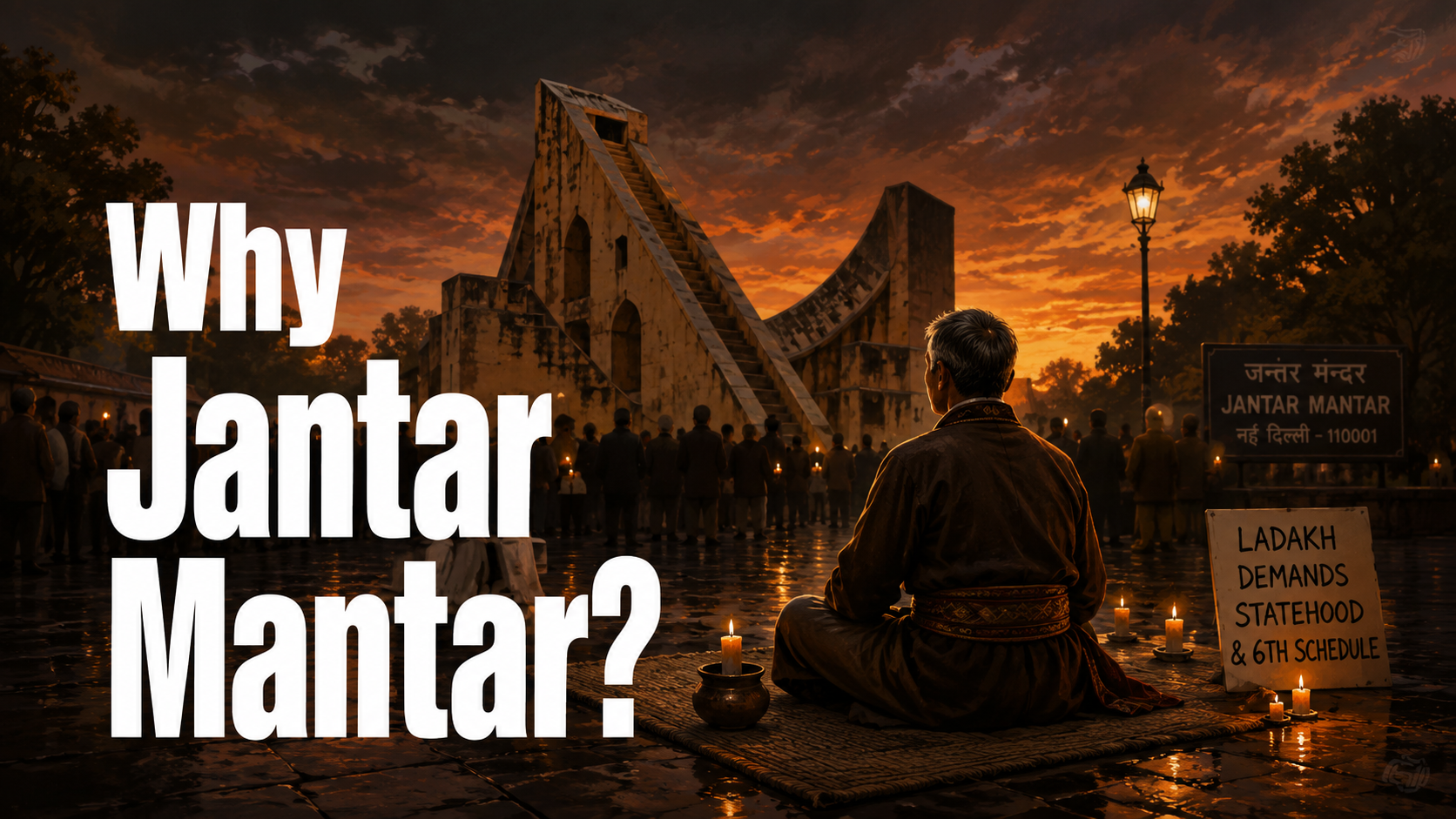
In July 2026, Jantar Mantar in New Delhi has once again become the centre of India’s political conversation. Sonam Wangchuk — the Ladakhi environmentalist and activist who inspired the character of Phunsuk Wangdu in 3 Idiots — is on an indefinite hunger strike here, demanding the resignation of Education Minister Dharmendra Pradhan over the NEET paper leak 2026.
Why Is Everyone Talking About Jantar Mantar Right Now?
The Cockroach Janta Party, or CJP, founded by Abhijeet Dipke, has been staging a sit-in for over 25 days alongside student organisations including SFI, AISA, and AISF. On July 20, thousands of Gen Z protesters gathered near Jantar Mantar defying Delhi Police orders, attempting to march toward Parliament as the Monsoon Session opened. Police responded with baton charges and tear gas. International media covered it. India watched.
But why here? Why does every major protest in India — from Anna Hazare’s anti-corruption movement to the Nirbhaya protests, from the anti-CAA demonstrations to the wrestlers’ dharna, and now the NEET protest 2026 — end up at this particular stretch of road in central Delhi? The answer goes back three centuries, and through one pivotal moment in 1988 that permanently changed India’s protest geography.
Built for Stars, Repurposed for Struggle
Maharaja Sawai Jai Singh II of Jaipur built Delhi’s Jantar Mantar in 1724 for a precise and scientific purpose — tracking the movement of celestial bodies, predicting eclipses, and measuring time with remarkable accuracy for that era. It was one of five such observatories he constructed across India, and it stands today as one of Delhi’s most extraordinary examples of pre-modern scientific architecture.
It was never designed for protest. No founding architect could have imagined that this 18th-century astronomical observatory would one day become the place where wrestlers demand justice, students march against examination fraud, farmers camp for weeks, and a Ladakhi environmentalist fasts for 18 days while the government watches in silence.
Yet that is precisely what Jantar Mantar has become. To understand why, you need to understand what it replaced — and why the government of the day made a decision in the early 1990s that permanently shaped the geography of Indian democratic dissent.
The Boat Club Era: When Protests Had Real Power
Before Jantar Mantar, Delhi’s dissent had a grander and far more confrontational stage.
The Boat Club lawns near Rajpath — now renamed Kartavya Path — served as the capital’s primary protest ground for decades. The location was deliberate and potent. Standing at the Boat Club, demonstrators had a direct line of sight to Parliament, Rashtrapati Bhavan, North Block, and South Block simultaneously. Those in power literally could not look out of their office windows without seeing the crowd.
Historically significant movements used this space. Jayaprakash Narayan’s Sampoorna Kranti campaign gathered there in 1975. Deputy Prime Minister Devi Lal held a massive rally there in 1990 during his public clash with Prime Minister V P Singh — a rally so significant that Singh announced the implementation of the Mandal Commission report partly to outmanoeuvre it.
The Boat Club, in other words, was where Indian democracy literally stared power in the face.
The Moment That Changed Everything: Tikait’s 1988 Siege
The decisive break came in October 1988. Mahendra Singh Tikait — the Bharatiya Kisan Union leader who would go on to become one of India’s most recognisable farmer leaders — led approximately five lakh farmers from western Uttar Pradesh and their cattle to the Boat Club lawns. They camped there for days. Their animals grazed on the manicured lawns. Delhi’s daily life was effectively paralysed.
The then-Rajiv Gandhi government was forced to concede to the farmers’ demands. The agitation succeeded completely.
However, its very success sealed the fate of the Boat Club as a protest venue. The government concluded that a space where half a million people could camp within eyeshot of the Parliament and bring the capital to a standstill was a security and administrative problem it could not keep tolerating. Consequently, by 1993, authorities had banned all protests at the Boat Club entirely, imposing a permanent Section 144 in the area.
Power had seen what proximity to power could do. It moved the protest site further away.
Why Jantar Mantar? The Logic of Controlled Visibility
When authorities needed an alternative to the Boat Club, Jantar Mantar Road presented an administratively convenient solution. The stretch between Ashoka Road and Tolstoy Marg — a narrow, tree-lined lane — offered proximity to Parliament without the dangerous openness of the Boat Club lawns.
Three factors made it suitable from the government’s perspective. First, its location close to Parliament gave protesters symbolic visibility — they could claim to be “at the gates of power” without actually being there. Second, the narrow road and its limited entry and exit points made crowd control significantly easier for police. Third, the presence of the Jantar Mantar monument itself — a protected archaeological site — gave the area a degree of gravitas that a random street would lack.
From the early 1990s onward, Jantar Mantar Road became the accepted, if never formally declared, site for protests in Delhi. No official order designated it. Instead, administrative practice gradually established it as the default — the place police would direct you to if you wanted to demonstrate in the capital.
As one activist, quoted in Gulf News, put it: “You can show your strength there.” And crucially — you can catch the eye of journalists milling around Parliament.
The Protests That Defined the Space
Over three decades, Jantar Mantar has hosted an extraordinary range of movements — a catalogue that reflects the full breadth of Indian democratic aspiration and grievance.
Anna Hazare’s anti-corruption movement in 2011, which generated the largest civil society mobilisation India had seen in a generation, centred on Jantar Mantar before moving to Ramlila Maidan. The movement directly gave birth to the Aam Aadmi Party — meaning that one of India’s major political parties was effectively born on this street.
The protests following the December 2012 Nirbhaya gang rape brought thousands of students and citizens to Jantar Mantar in some of the most emotionally charged demonstrations independent India has seen. Similarly, the 2020 Hathras rape case protests gathered at Jantar Mantar after authorities barricaded India Gate and Mandi House.
The anti-CAA protests of 2019-2020 saw Jantar Mantar become a gathering point after demonstrations planned at the Red Fort and Mandi House were blocked. In 2023, India’s top wrestlers — Bajrang Punia, Vinesh Phogat, and Sakshi Malik — staged their months-long protest against Wrestling Federation of India chief Brij Bhushan Sharan Singh on this same street, in one of the most uncomfortable moments for the BJP government in recent years.
Furthermore, the 2026 NEET protests led by the Cockroach Janta Party, which drew Sonam Wangchuk’s indefinite hunger strike and ultimately a march toward Parliament on July 20, are only the latest chapter in this long history.
As we reported in our full explainer on Wangchuk’s hunger strike, the pattern at Jantar Mantar has remained consistent regardless of the government in power — a designated space that offers the appearance of democratic dialogue while limiting its actual disruptive capacity.
The Legal Battles: When Even Jantar Mantar Got Restricted
The irony of Jantar Mantar’s story deepened considerably after 2017.
In October 2017, the National Green Tribunal banned all protests at Jantar Mantar after petitions from area residents complained about noise and pollution. Suddenly, protesters found themselves without either of their traditional central Delhi venues — the Boat Club had been banned since 1993, and now Jantar Mantar was off-limits too. The only remaining designated protest sites were Ramlila Maidan and Burari — both distant from Parliament, both lacking symbolic weight, and one of them expensive enough to effectively price out smaller movements.
In July 2018, the Supreme Court intervened. The bench ruled that there could be no complete ban on protests in central Delhi’s Jantar Mantar and Boat Club areas, upholding citizens’ constitutional right to voice dissent. However, the court also mandated that protests could not obstruct traffic or endanger residents, and directed Delhi Police to draft guidelines.
The result has been a legal grey zone that continues to this day. Protests happen at Jantar Mantar. Police periodically restrict or redirect them. The Supreme Court’s position provides a constitutional floor of protection. Yet the practical experience of demonstrating there depends heavily on which government is in power, what the protest is about, and how the police of the day choose to interpret their guidelines on any given afternoon.
What Jantar Mantar Represents: A Controlled Safety Valve
The deeper significance of Jantar Mantar in Indian democracy is somewhat unsettling when examined directly.
The site exists, at least in part, because the government of 1993 decided that protests close enough to Parliament to actually confront power were too dangerous. The Boat Club was banned. A narrower, more controllable space was substituted. Jantar Mantar gives India’s democracy a visible, photogenic protest site — one that satisfies the constitutional requirement that citizens be allowed to dissent — while ensuring that dissent remains at a manageable distance from the institutions being dissented against.
This is not a uniquely Indian phenomenon. London has Hyde Park. Washington has Lafayette Square. Every democracy needs a space where voices gather — and every government has an interest in ensuring that space is not quite close enough to power to be genuinely threatening.
Nevertheless, the history of Jantar Mantar suggests that the calculation does not always work as governments intend. Anna Hazare’s protests there helped topple the UPA’s second term. The wrestlers’ dharna embarrassed the BJP at the height of its power. And in July 2026, a Gen Z satirical party and a fasting environmentalist made this narrow stretch of road the most talked-about place in India — generating international media coverage and defining the opening week of the Monsoon Session.
In the end, you can control where people protest. You cannot always control what the protest becomes.
The 2026 Moment: History Repeating
The current protests at Jantar Mantar carry echoes of every major movement this space has witnessed. Like the Anna Hazare movement, they are driven by young people whose frustration with existing institutions goes well beyond the immediate demand. Like the Nirbhaya protests, they carry a genuine moral weight that makes political calculation difficult. And like the 1988 Boat Club siege that created Jantar Mantar’s role in the first place, they have forced the government into a posture of visible non-response that is itself becoming politically costly.
Maharaja Jai Singh built his observatory to read the stars — to find patterns in the celestial movements and use them to understand what was coming. Three centuries later, the space he created has become a place where India reads different patterns: the movement of citizens, the response of governments, and the gap between the two that periodically makes democratic dissent not just necessary but inevitable.
That gap has rarely looked wider than it does in July 2026.