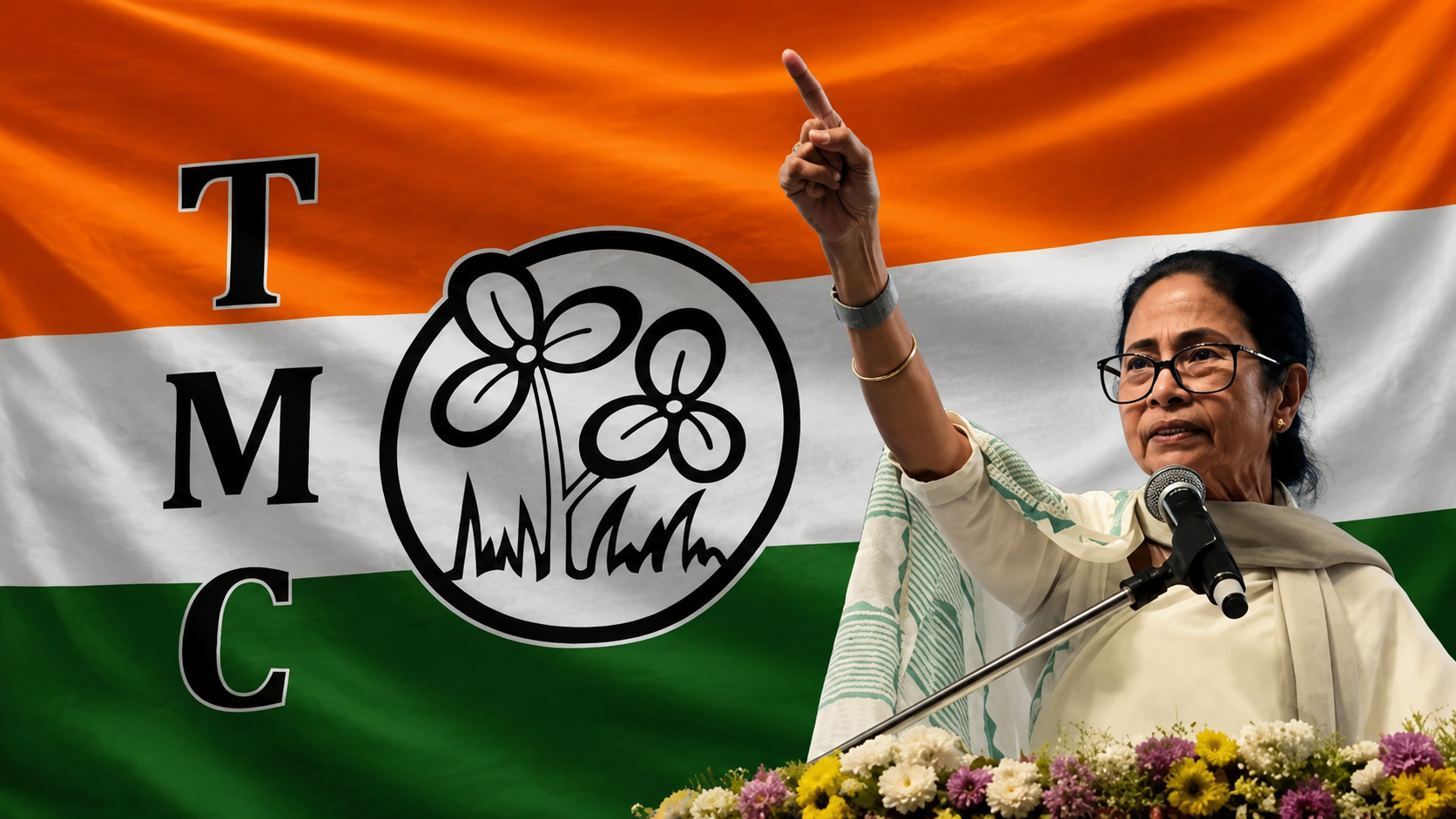
The Trinamool Congress has never split in its 28-year history. Not through the Emergency controversies, not through electoral setbacks, not through the turbulent years of fighting the Left, not even through the bitter loss of the 2024 Lok Sabha seats. Through every crisis, Mamata Banerjee’s iron grip on her party held.
On June 3, 2026, that grip cracked — publicly, dramatically, and in a way that cannot be easily walked back.
Fifty-eight TMC MLAs submitted a letter to West Bengal Assembly Speaker Rathindra Bose, backing expelled MLA Ritabrata Banerjee as the Leader of Opposition in the state assembly. The Speaker accepted the letter. The rebel faction — comprising nearly three-quarters of TMC’s 80-member legislature party — declared itself the principal opposition in the 18th West Bengal Legislative Assembly. Ritabrata Banerjee, just two days after being expelled from the party, stood before cameras and announced that Abhishek Banerjee — the man most assumed would inherit Mamata’s mantle — would have “absolutely no role” in the legislature wing now controlled by the rebels.
It is the most significant internal political crisis TMC has faced since its founding in 1998.
Timeline: How We Got Here
Understanding the crisis requires tracing the fault lines that were forming long before June 3.
May 4, 2026 — Election Defeat The Trinamool Congress suffers a historic defeat in the West Bengal assembly elections, losing power to the BJP after 15 years of uninterrupted rule. TMC wins only 80 of 294 seats. The scale of the defeat — unexpected by many within the party — triggers immediate internal blame and recrimination.
At Mamata Banerjee’s first public rally after the defeat, only eight of the party’s 80 elected MLAs showed up. The optics were devastating. The message was unmistakable: large sections of the legislature party had quietly detached from the leadership.
May 9, 2026 — BJP Takes Power Suvendu Adhikari is sworn in as Chief Minister of West Bengal. TMC transitions to opposition. The party announces Sobhandeb Chattopadhyay — a founding member and Mamata loyalist since the mid-1980s — as Leader of Opposition. Kalyan Banerjee writes to the Assembly Speaker formally nominating Chattopadhyay for the post.
Behind the scenes, a group of MLAs increasingly unhappy with the party’s leadership structure — and specifically with the dominant influence of Abhishek Banerjee and the political consultancy firm I-PAC — begin organising. Ritabrata Banerjee and Sandipan Saha emerge as the focal points of dissent.
June 1, 2026 — The Expulsions TMC expels two MLAs — Ritabrata Banerjee and Sandipan Saha — with immediate effect, citing anti-party activities. The specific trigger: allegations that the rebel duo had forged signatures on a proposal related to the LoP appointment.
The expulsion was intended to be a routine disciplinary measure. Instead, it lit the match. Within hours, it became clear that the rebel camp had far broader support than the leadership had anticipated.
June 3, 2026 — The Letter Ritabrata Banerjee arrives at the West Bengal Assembly with a letter signed by 58 TMC legislators — comfortably crossing the two-thirds threshold of 54 required under anti-defection law. The letter recognises Mamata Banerjee as the leader of the party but appoints Ritabrata as Leader of Opposition, with Seuli Saha and Javed Ahmed Khan as deputy leaders.
The rebel MLAs arrive in buses — a deliberate show of strength — to attend the ongoing session.
Speaker Rathindra Bose accepts the letter. The rebel faction is recognised as the principal opposition in the assembly.
TMC dissolves all party organisational units. Kolkata Mayor Firhad Hakim, reportedly expressing a desire to step down amid the crisis, had his resignation accepted by the party.
The Current Scenario: Two Factions, One Symbol
West Bengal now has two competing claimants to the TMC legislature party — and both sides are claiming legitimacy.
The Rebel Camp — Ritabrata Banerjee faction: 58 MLAs. Speaker recognition. Two-thirds majority of the legislature party. Ritabrata as LoP. Mamata acknowledged as party leader — but Abhishek explicitly excluded. Ritabrata has been direct and unambiguous: “Abhishek Banerjee will have absolutely no role in it. Neither our legislative party nor the party organisation has any connection whatsoever with him.”
The rebels are careful to maintain one thing: they are not anti-Mamata. They are anti-Abhishek, and anti-I-PAC. By keeping Mamata’s name in their letter as party leader while excluding Abhishek entirely, they are attempting to drive a wedge — positioning themselves as the true loyalists and Abhishek as the real problem.
The Loyalist Camp — Mamata’s faction: Sobhandeb Chattopadhyay as their LoP nominee. Kalyan Banerjee as the loyalist voice. Old guard figures who showed up at Mamata’s rally. The party organisation formally behind them. And Mamata Banerjee herself — who has, so far, not made a public statement on the crisis.
That silence from Mamata is striking. It is either strategic — buying time to assess the situation — or a sign that the scale of the rebellion has left her without an immediate response. Either way, it is unprecedented.
What Does the Law Say?
This is where the crisis moves from political drama into constitutional territory — and where the rebel camp’s strategy becomes clear.
The Tenth Schedule — Anti-Defection Law
Added to the Constitution through the 52nd Amendment in 1985, the Tenth Schedule governs defection and disqualification of elected legislators. Under its provisions, an MLA who voluntarily gives up membership of a political party or votes against the party’s whip can be disqualified.
However — and this is the critical exception — a split is protected if at least two-thirds of the legislature party supports it.
TMC won 80 seats. Two-thirds of 80 is 54. The rebel camp has 58 signatories, with two more reportedly willing to join. They have crossed the threshold comfortably.
This means: the rebel MLAs cannot be disqualified under the anti-defection law. They are legally protected in their rebellion, regardless of what the TMC party organisation decides to do.
The Speaker’s Role
The Speaker of the Assembly is the authority who decides recognition of the legislature party and the LoP. Speaker Rathindra Bose has accepted the rebel faction’s letter — a significant development that effectively legitimises their claim to the legislature wing, at least for now.
However, the Speaker’s decision is not final and can be challenged. As the Supreme Court noted in 2019, there is a growing concern about speakers acting in partisan ways in defection cases.
The Election Commission — The Symbol Question
Here is where it gets more complicated, and more consequential.
Under anti-defection law, a split in the legislature party is protected. But control over the party organisation and the election symbol is an entirely separate matter — determined by the Election Commission of India, not the Speaker.
Any future claim over the party symbol — the iconic Mamata-era TMC flag — would depend on several factors: support within the party’s organisational structure, the position of state and national executive committees, provisions of the party constitution, and backing from elected representatives across all levels.
The rebel faction has the legislature numbers. But the party organisation — at least formally — remains with Mamata. The Election Commission will look at both when deciding who controls the symbol.
This is where the Shiv Sena precedent becomes relevant. When Eknath Shinde’s faction broke from Uddhav Thackeray in 2022, it had the legislature numbers. The Election Commission ultimately granted Shinde’s faction the party name and symbol — but that process took months of proceedings, evidence, and legal argument.
TMC faces the same question. If the rebel camp moves to claim the party and its symbol, the ECI will have to determine which faction represents the “real” TMC. That is a process neither side can predict with certainty.
Our Take: Mamata Will Not Compromise
Here is where we give you the ObserverFile assessment — not a recap of what others have said, but what we believe is actually happening and what comes next.
Mamata Banerjee will not compromise. Not with the rebel faction, not on Abhishek, and not on the party symbol.
Here is why.
First, her entire political identity is the party. Mamata did not inherit TMC — she built it from scratch in 1998, breaking from Congress, fighting the Left for over a decade, and winning power in 2011. The party is not separate from her — it is an extension of her. Handing any part of it to a rebel faction would be, for her, a form of political death she will not accept voluntarily.
Second, the rebel camp’s strategy reveals its own weakness. By explicitly keeping Mamata’s name in their letter while targeting Abhishek, the rebels are signalling that they do not have the confidence to go fully anti-Mamata. They need her name for legitimacy. That gives Mamata leverage — she can, at any moment, publicly denounce the rebel faction and make their political position untenable with her core voter base.
Third, the Election Commission process takes time — and Mamata knows how to fight long battles. The rebel faction may have the legislature numbers today. But converting that into control of the party symbol requires winning a protracted institutional battle. Mamata has legal resources, organisational depth at the district and block level, and a personal voter loyalty that no rebel MLA individually commands.
Fourth, the Shiv Sena lesson cuts both ways. Yes, the Shinde faction ultimately won the symbol. But it did so because it had both the legislature numbers and a functioning government — with state resources behind it. The TMC rebels are in opposition, in a state governed by their political opponents. They have no state machinery behind them. The comparison to Shiv Sena flatters the rebel camp more than the facts warrant.
What we expect: Mamata will stay silent for now, allow the Speaker’s decision to play out, and simultaneously move to consolidate the organisational base. She will make a dramatic public statement at a moment of her choosing — not in reaction to the rebels’ timeline. She will then approach the Election Commission proactively to pre-empt any symbol claim. And she will, eventually, attempt to peel individual MLAs away from the rebel bloc, using the combination of personal loyalty and the political reality that without her name and symbol, most of these MLAs cannot win another election.
The rebellion is real. The crisis is genuine. But writing off Mamata Banerjee has been a losing bet for every political opponent she has faced in 35 years of public life.
The file on this split is open. It is far from closed.
Also read: Stones, Eggs and a Torn Shirt: What the Attack on Abhishek Banerjee in Sonarpur Really Tells Us
Also read: This Is Not the First Time: Abhishek Banerjee’s Convoy Has Been Attacked Before
ObserverFile is an independent political news and analysis platform covering Bengal and national politics — News Beyond the Noise.