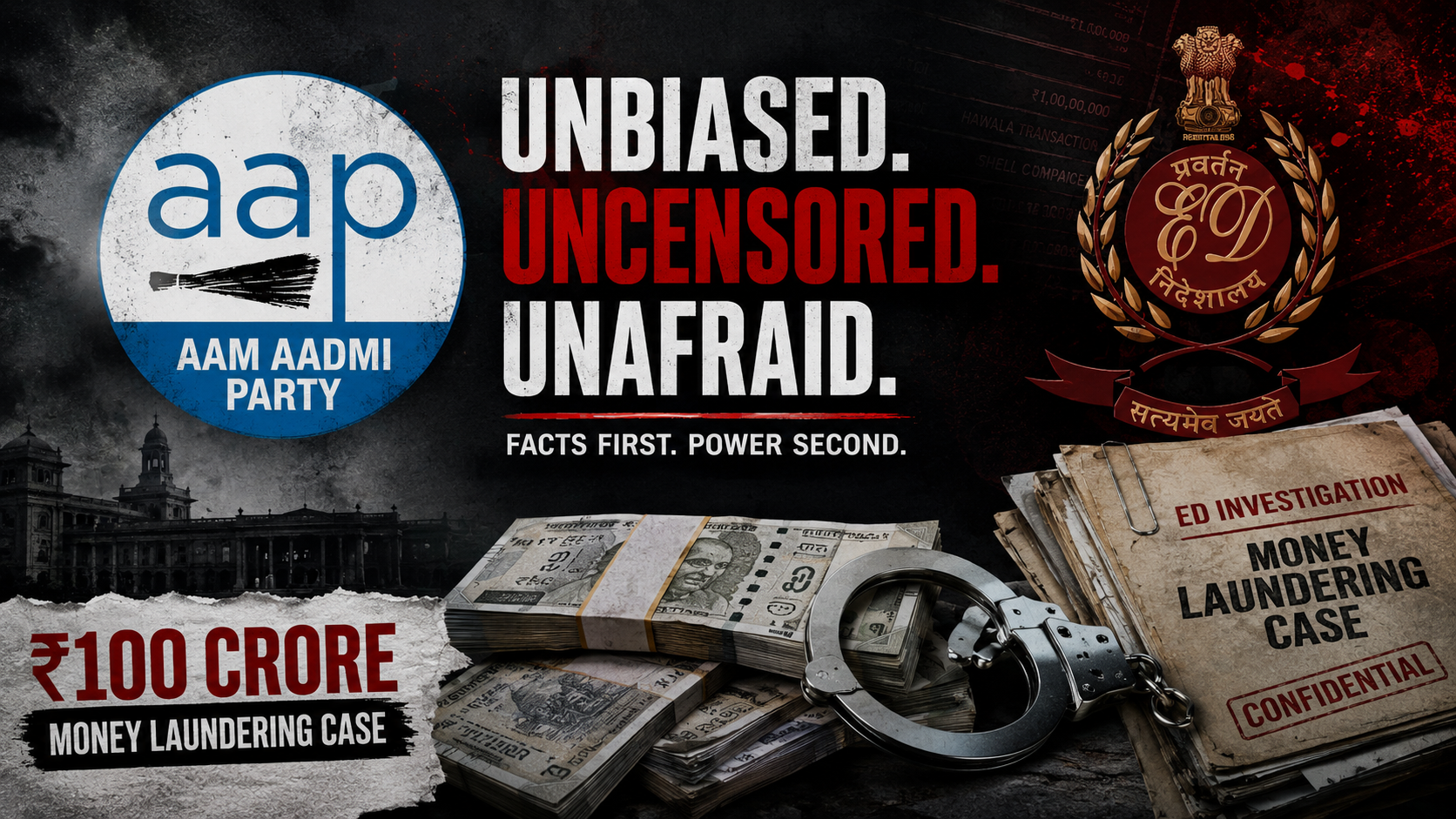
Punjab politics witnessed another major controversy after the Enforcement Directorate (ED) arrested Punjab minister and AAP leader Sanjeev Arora in connection with an alleged ₹100 crore money laundering case linked to fake GST transactions.
The arrest has intensified the political confrontation between the Aam Aadmi Party (AAP) and the BJP-led Centre, with both sides accusing each other of corruption and political vendetta.
The case has quickly become one of the biggest political developments in India because it combines allegations of fake GST billing, hawala transactions, UAE-linked financial routing, and questions surrounding the use of central investigative agencies in Indian politics.
This article explains:
- the complete ED case,
- the allegations against Sanjeev Arora,
- AAP’s response,
- BJP’s counterattack,
- and the larger political implications for Punjab and national politics.
Who Is Sanjeev Arora?
Sanjeev Arora is a businessman-turned-politician associated with the Aam Aadmi Party (AAP). He has been one of the prominent faces of the party in Punjab and held important ministerial responsibilities related to industries, commerce, and local governance.
Before entering politics, Arora was known in business circles in Punjab, particularly in sectors linked to trade and real estate.
After AAP formed the Punjab government under Chief Minister Bhagwant Mann, Arora emerged as an influential minister involved in attracting industrial investments into the state.
Earlier this year, Arora claimed Punjab secured investment commitments worth ₹1.5 lakh crore under the AAP government, positioning himself as one of the architects of Punjab’s industrial growth strategy.
However, his political career is now facing serious scrutiny after repeated ED raids and his subsequent arrest.
What Is the ₹100 Crore Money Laundering Case?
According to the Enforcement Directorate, the investigation revolves around alleged fake GST transactions involving mobile phone purchases worth more than ₹100 crore.
Key Allegations by the ED
The ED claims that:
- fake firms were allegedly created in Delhi and other regions,
- fraudulent invoices for mobile phone purchases were generated,
- fake Input Tax Credit (ITC) claims were made,
- GST refunds and export incentives were allegedly obtained illegally,
- and funds were routed through hawala channels and overseas entities.
Investigators also suspect that money was allegedly routed through Dubai before being brought back into India.
Laws Involved in the Investigation
The investigation reportedly involves:
- Prevention of Money Laundering Act (PMLA),
- Foreign Exchange Management Act (FEMA),
- and GST fraud-related provisions.
The ED has stated that multiple associates and entities linked to Arora are under investigation.
ED Raids Before the Arrest
The arrest did not happen suddenly.
Over the past several months, the Enforcement Directorate had already conducted multiple searches linked to Sanjeev Arora and his associates.
Locations Targeted During the Raids
Reports suggest the ED conducted searches at properties linked to Arora in:
- Ludhiana,
- Chandigarh,
- Delhi,
- Gurugram,
- and Haryana.
The raids reportedly targeted:
- residences,
- business offices,
- and firms allegedly connected to the investigation.
Central security personnel accompanied ED officials during several operations.
Bhagwant Mann’s Response to Earlier Raids
Punjab Chief Minister Bhagwant Mann claimed the ED had previously searched Arora’s residence multiple times but allegedly “found nothing.”
The repeated ED actions had already turned the controversy into a major political flashpoint before the arrest itself took place.
What Exactly Is the ED Alleging?
The ED’s allegations go beyond ordinary tax evasion.
According to reports:
- fake firms allegedly issued fraudulent invoices,
- goods shown in transactions allegedly did not actually exist,
- fake export claims were allegedly used to secure GST refunds,
- and funds were allegedly moved through international channels.
The ED’s Suspected Financial Network
Investigators believe the network may have been designed to:
- create fake transactions,
- illegally claim tax benefits,
- and launder money through international routing systems.
If proven in court, the allegations could amount to large-scale economic offences.
However, it is important to note that the investigation is still ongoing and no court has established guilt yet.
AAP’s Response: “Political Vendetta”
The Aam Aadmi Party has strongly denied wrongdoing and accused the BJP-led central government of using agencies like the ED for political targeting.
Bhagwant Mann’s Reaction
Punjab Chief Minister Bhagwant Mann reacted aggressively after the arrest and raids.
He claimed:
- the BJP was attempting to intimidate Punjab,
- the ED was being used politically,
- and Punjab would not bow before pressure politics.
AAP’s Main Arguments
AAP leaders questioned:
- why opposition leaders frequently face ED action,
- why many politicians appear to receive relief after joining the BJP,
- and whether agencies are being selectively used against opposition parties.
The party has framed the case as part of a larger national battle between opposition parties and the BJP government at the Centre.
BJP’s Counterattack
The BJP has rejected AAP’s claims and argued that corruption allegations cannot simply be dismissed as “political vendetta.”
Punjab BJP leaders stated:
- investigative agencies are acting based on evidence,
- corruption allegations against ministers must be investigated,
- and AAP is attempting to divert attention from serious accusations.
BJP leaders also claimed the controversy exposes internal divisions within AAP and damages the party’s anti-corruption image.
Why This Case Matters Politically
The Sanjeev Arora controversy is politically significant for multiple reasons.
AAP’s Anti-Corruption Image
AAP was built around the anti-corruption movement led by Arvind Kejriwal and Anna Hazare.
Corruption allegations against senior AAP leaders directly affect the party’s political identity and credibility.
Punjab Is AAP’s Strongest State
After setbacks in several states, Punjab remains AAP’s strongest major state government.
Any major controversy in Punjab affects:
- AAP’s national image,
- organizational strength,
- and future electoral strategy.
Debate Around Central Agencies
The case has once again revived debates around:
- ED raids,
- CBI investigations,
- and the role of central agencies in politics.
Opposition parties continue to accuse the BJP government of weaponizing investigative agencies, while the BJP argues corruption probes are legitimate.
The GST Fraud Angle Explained
One reason this case has gained national attention is the alleged GST fraud component.
Common GST Fraud Techniques
GST fraud cases in India often involve:
- fake invoicing,
- shell companies,
- circular trading,
- fake exports,
- and fraudulent ITC claims.
Authorities believe such frauds cause massive losses to the government.
In this case, investigators suspect fake purchase bills for mobile phones were used to claim illegal GST benefits.
Why Dubai Keeps Appearing in Such Cases
Many Indian financial crime investigations involve references to Dubai because:
- it is a major global trade hub,
- international business routing is common there,
- hawala channels have historically used Gulf routes,
- and shell company structures can become difficult to trace internationally.
The ED alleges funds in this case were routed through Dubai before returning to India.
However, investigators will still need to establish financial evidence and documentary proof in court.
Public Reaction on Social Media
Social media reactions have been sharply divided.
BJP Supporters’ View
Supporters of the BJP argue:
- corruption investigations should continue regardless of political affiliation,
- and AAP’s anti-corruption narrative has collapsed.
AAP Supporters’ View
AAP supporters argue:
- ED actions disproportionately target opposition parties,
- investigations become politically active before elections,
- and similar scrutiny is not applied equally to ruling-party leaders.
Online discussions have also revived terms like:
- “Operation Lotus,”
- “washing machine politics,”
- and “agency politics.”
Can the Arrest Impact Punjab Government Stability?
As of now, there is no indication that the Punjab government itself is under immediate threat.
However, the controversy creates several political challenges:
- damage to governance image,
- questions around ministerial accountability,
- pressure on AAP leadership,
- and opposition attacks ahead of future elections.
If more arrests or stronger financial evidence emerge, the controversy could deepen further.
Legal Process Ahead
After arrest, the legal process may include:
- ED custody or judicial custody,
- interrogation,
- examination of financial records,
- court hearings,
- bail proceedings,
- and filing of prosecution complaints or chargesheets.
What the ED Will Attempt to Prove
The agency will likely attempt to establish:
- source of funds,
- financial routing,
- beneficiaries,
- associated entities,
- and international transactions.
Possible Defence Arguments
The defence may argue:
- political targeting,
- lack of direct evidence,
- procedural irregularities,
- and legitimacy of business transactions.
The legal process could continue for months or even years.
Impact on AAP’s National Ambitions
AAP has attempted to expand nationally beyond Delhi and Punjab.
However:
- corruption allegations,
- ED investigations,
- arrests,
- and legal controversies
have complicated that strategy.
The Sanjeev Arora case adds to previous controversies involving AAP leaders and increases political pressure on the party nationally.
The Bigger Question: Corruption Fight or Political Warfare?
The biggest question surrounding the case is whether it is:
- a genuine corruption investigation,
- or an example of politically influenced agency action.
BJP’s Position
The BJP argues:
- agencies are independent,
- corruption must be investigated,
- and no politician should receive immunity.
Opposition’s Position
Opposition parties argue:
- agencies selectively target opposition leaders,
- investigations are politically timed,
- and central agencies are being weaponized.
Public opinion remains deeply divided.
Conclusion
The arrest of Punjab minister Sanjeev Arora in the alleged ₹100 crore money laundering case has become much more than a financial crime investigation.
It now sits at the intersection of:
- corruption allegations,
- GST fraud investigations,
- opposition politics,
- ED activism,
- and the larger battle between AAP and BJP.
The ED alleges fake GST transactions, hawala-linked financial routing, and international money laundering involving shell firms and fraudulent export claims.
AAP, meanwhile, insists the case reflects political misuse of agencies against opposition leaders.
As the investigation proceeds, both the legal battle and political narrative surrounding the controversy are expected to intensify further.