To understand why July 21 matters more than any other date in Bengal’s political calendar, you need to go back to a single afternoon in Calcutta in 1993 — and to a young woman who climbed a traffic police post in the middle of Brabourne Road while bullets flew around her.
The date was July 21, 1993. Mamata Banerjee was 38 years old, the state president of the West Bengal Youth Congress, and she had just organised one of the most consequential — and most violent — protest marches in the history of Bengal’s opposition politics.
What happened that afternoon did not just mark her politically. It defined her. And it set in motion a chain of events that would ultimately end 34 years of Left Front rule, produce Bengal’s most dominant political figure of the modern era, and give the Trinamool Congress its most powerful annual ritual.
Writers’ Chalo Abhiyan: What Actually Happened
The Writers’ Building in Calcutta served as the office of the Chief Minister of West Bengal. Getting to it — physically, politically — was the Left Front’s ultimate fortress. Mamata Banerjee chose it as her target.
Her demand was straightforward: make photo voter identity cards the only valid document for voter verification, to put an end to what she called “scientific rigging” — the systematic manipulation of elections that had kept the Left Front in power since 1977.
Youth Congress workers gathered at five different points across the city and began marching toward Writers’ Building along Brabourne Road. They were stopped by a large contingent of police officials near the Tea Board office, barely minutes away from their destination. The police began beating the crowd to drive them away from the Writers’ Building vicinity.
What followed descended rapidly into violence. Section 144 had been enforced beyond Mayo Road crossing. Around 1:45 PM, after tear gas and baton charges failed to disperse the crowd, police opened fire — killing 13 people and injuring hundreds more. The Police Commissioner at the time, Tushar Talukdar, claimed at a press conference afterward that he had been unaware of the firing order. When journalists asked why officers had aimed at protesters’ torsos rather than their legs — a basic standard of crowd control — Talukdar said the police would inquire into it. A damning detail from a subsequent inquiry revealed that 21 years later, officials told the commission that the report files had gone missing from both the Lalbazar police headquarters and the Writers’ Building itself.
Thirteen people were dead. Hundreds were injured. And Mamata Banerjee — who had been injured herself, who had climbed a traffic police post in the middle of the road before being surrounded by Youth Congress workers who formed a human shield around her — had just become something she had never quite been before: a martyr figure.
The Controversy That History Glosses Over
The full history of July 21, 1993 is more contested than TMC’s annual commemoration suggests — and an honest account requires acknowledging that.
The official reason for the protest was to demand mandatory voter ID cards, which were the responsibility of the Election Commission of India, not the state government. Critics noted this raised questions about the real motive behind the march. The rally came shortly after Mamata had lost an internal Congress election to Somen Mitra for the state youth wing’s presidency — a defeat she attributed to an internal conspiracy.
Former Chief Minister Buddhadeb Bhattacharjee, who was then Information and Cultural Affairs Minister in the Jyoti Basu cabinet, justified the firing before the judicial commission, saying it was an attempt to capture the Writers’ Building and that large-scale violence had resulted in around 70 policemen being injured. Justice Chattopadhyay, heading the inquiry, noted pointedly that no record had been found of any policeman being admitted to hospital on that day.
The commission’s final report, submitted in December 2014 after three years of proceedings, concluded that 75 rounds were fired by police. It also concluded, controversially, that one of the 13 deceased had died from cirrhosis of the liver rather than police gunfire.
None of this erases the deaths of 12 people from police bullets. But it is part of the historical record that deserves acknowledgment alongside the narrative of martyrdom.
What the Firing Did to Bengal’s Politics
Whatever the full circumstances of July 21, 1993, its political consequences were unambiguous and enormous.
The Left Front, which had governed West Bengal with near-total dominance since 1977, had used state force against a protest march in the heart of Calcutta. The public reaction — particularly among young voters — was visceral. Mamata, injured and photographed being escorted away, became the face of the opposition to Left rule in a way she had never quite managed before.
She carried that moral authority through the years that followed. The experience of July 21 came directly into play when she led mass protests against the CPI(M) government in Singur and Nandigram between 2005 and 2007. Those protests — against the forcible acquisition of agricultural land for industry — drew on the same vocabulary of state violence and citizen resistance that July 21 had established.
By 2011, Mamata Banerjee had ended 34 years of Left Front rule in West Bengal. She entered the Writers’ Building as Chief Minister. The same building she had marched toward in 1993, the same building where 13 of her people had died trying to reach — she finally entered it as the most powerful person in the state. The circle closed completely.
July 21 as an Annual Institution
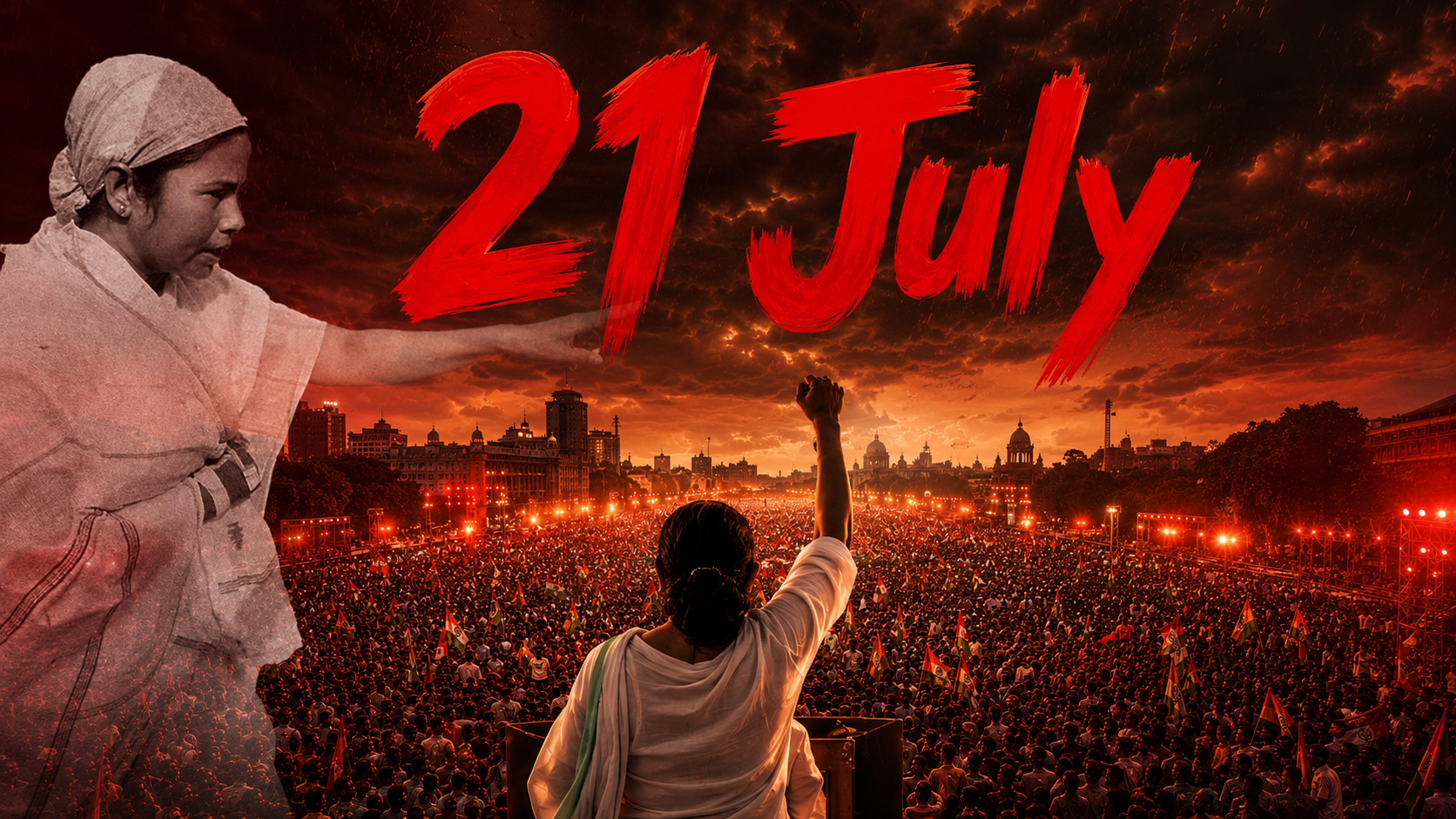
After founding the All India Trinamool Congress in 1997, Mamata converted the annual July 21 commemoration into the party’s most important yearly event. The Shahid Diwas rally at Esplanade More (Dharmatala) became the single biggest political gathering in Bengal’s calendar.
At its peak, the rally drew millions of TMC workers and supporters from across Bengal — arriving in buses, trains, and on foot. Mamata would address the crowd from the main stage, delivering a political speech that set the tone for the party’s agenda for the year ahead. The rally’s size was routinely cited as proof of TMC’s organisational strength and grassroots reach.
It is worth noting that both the Congress and TMC continue to observe July 21 as Martyrs’ Day — the Congress because the 13 who died were Youth Congress workers, and TMC because the main organisers of the 1993 march broke away from Congress to found TMC in 1997 and took the commemoration with them.
For Mamata personally, July 21 was the day she could point to and say: these people died for this cause, and we are still here. It was the emotional and historical foundation on which the entire TMC superstructure was built.
2026: The Rally That Nobody Knows Who Owns
Then came 2026. TMC lost power in May. The party split in June, with 58 MLAs backing Ritabrata Banerjee as Leader of Opposition — as we reported in detail in our piece on TMC’s first split in 28 years. Dozens of senior TMC leaders crossed over to the rebel faction. And suddenly, the question of who gets to hold the July 21 rally — the most sacred event in Mamata’s political calendar — became live, contested, and genuinely uncertain.
Both the rebel faction and Mamata’s loyalist camp have approached the Kolkata Police seeking permission to hold their versions of the Shahid Diwas rally on July 21 at Victoria House in the Esplanade area.
The rebel faction, led by Ritabrata Banerjee, is actively planning the rally and has stated that top party functionaries, the party chairperson, and the state president were all present in planning the event. When asked whether Mamata Banerjee would be invited to attend, the rebel camp said the matter had not yet been formally discussed.
Read that again carefully. The woman who created July 21, who built the rally from a commemoration of 13 deaths into Bengal’s biggest political gathering, who has addressed the crowd from that Esplanade stage every single year for three decades — may not even receive a formal invitation to attend in 2026.
According to a section of the political circle, Mamata wants to use the Esplanade rally stage as the last tool to save the party organisation.
Meanwhile, BJP has entered the conversation too. Bengal Minister Dilip Ghosh has alleged that Mamata Banerjee “hijacked” the Martyrs’ Day rally, stating that July 21 is not some TMC programme. The BJP’s argument is historically interesting — the 13 who died in 1993 were Youth Congress workers, not TMC workers. TMC did not exist until 1997.
The deeper question this raises: who actually owns the memory of July 21, 1993? The families of the 13 who died? The Congress, whose workers they were? Mamata, who led the march? Or TMC, the party she built on its legacy?
The Real Test of July 21, 2026
July 21 has always been more than a rally. It has been proof of Mamata’s ability to mobilise — the annual demonstration that her organisation was alive, disciplined, and loyal. When the crowd at Esplanade numbered in the millions, it sent a message to every political opponent: this woman commands Bengal.
In 2026, that mobilisation capacity is in question. The rebel faction has the legislature numbers. But Mamata still commands something the rebels do not — the direct emotional loyalty of TMC’s core voter base, the memory of July 21 itself, and three decades of relationship-building with Bengal’s grassroots political networks.
The rebels can plan the rally. They can book the stage and coordinate with the police. But can they fill Esplanade the way Mamata could? Can they draw crowds from Murshidabad, Purulia, North Bengal, and the Sundarbans to Kolkata on a hot July afternoon — without her name on the poster?
That is the real test of July 21, 2026. Not who gets the police permission. But whose version of July 21 Bengal actually shows up for.
Our Take
July 21 is Mamata Banerjee’s origin story. It is the day she almost died, the day 13 people did die, and the day that gave her the moral authority she has wielded in Bengal’s politics for the three decades since. No legal proceeding, no party split, and no Speaker’s ruling can strip her of that history.
But history alone does not fill a stage. And in 2026, for the first time, she may be watching July 21 from the outside — as a former Chief Minister, an uninvited guest at her own party’s most sacred ritual, fighting with a rebel faction over who gets to claim the memory of 13 people who died demanding fair elections.
The irony is complete. The day that made her may be the day that marks the beginning of the end.
Or — and this is equally possible — it may be the day she reminds everyone why writing off Mamata Banerjee has always been a losing bet.
July 21 is six days away. Bengal is watching.