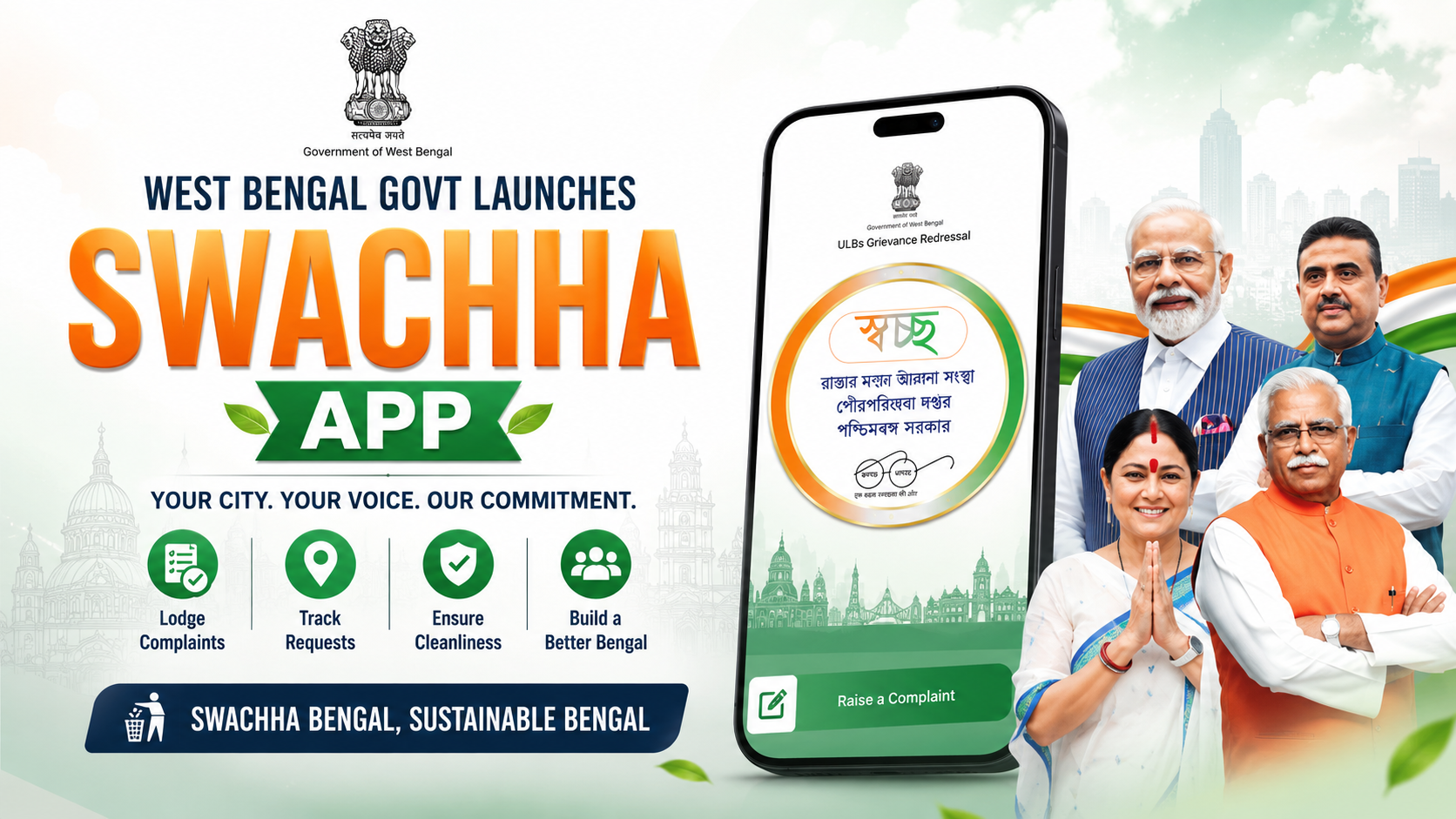

West Bengal’s new BJP government has launched a fresh citizen grievance redressal initiative called “Apnar Sorkar Apnar Pashe” — Bengali for “Your Government, By Your Side” — along with a dedicated helpline number, 8282082820, and an email ID, asap@wb.gov.in.
The initiative was announced by Chief Minister Suvendu Adhikari at Nabanna Sabhaghar, in the presence of state cabinet ministers, during the same event where the first phase of the Annapurna Yojana payments — Rs 3,000 each to 28.25 lakh women beneficiaries — was rolled out.
While the headline of that day was the welfare scheme payout, the launch of Apnar Sorkar Apnar Pashe is, in some ways, the more structurally significant move. It replaces the grievance redressal architecture built by the previous TMC government — and in doing so, it tells us something about how the new administration intends to manage its relationship with citizens.
What Is Apnar Sorkar Apnar Pashe?
At its core, Apnar Sorkar Apnar Pashe is a public outreach and grievance redressal mechanism — a way for citizens to flag problems with government schemes, services, or officials directly to the state administration.
The mechanism currently operates through two channels:
A helpline number, 8282082820, operational from 9 AM to 6 PM, Monday to Saturday.
A dedicated email address, asap@wb.gov.in, for written complaints.
In its initial phase, the platform is closely tied to the Annapurna Yojana rollout — citizens can use it to report cases where an eligible woman’s name is missing from the beneficiary list, or conversely, where an ineligible name appears to have been included. The government has stated that every complaint will trigger an inquiry, with verification handled through a multi-step chain involving block-level extension officers and Block Development Officers.
But the framing of the initiative — as a general “your government, by your side” outreach drive rather than a scheme-specific helpline — suggests the government intends to expand its scope over time, much as its predecessor did.
What It Replaces: The TMC’s “Sarasari Mukhyamantri” and “Didi Ke Bolo”
To understand why this launch matters beyond its immediate function, it helps to look at what came before it.
The Apnar Sorkar Apnar Pashe initiative replaces Sarasari Mukhyamantri (Directly, with the CM), which was launched by the previous Trinamool Congress government in June 2023. Before Sarasari Mukhyamantri, the TMC government had run an earlier version of the same idea under the name Didi Ke Bolo (Tell Didi).
Sarasari Mukhyamantri itself was launched with considerable fanfare. When Mamata Banerjee unveiled it in 2023, the platform was built around a call centre and field validation units, with around 500 tele-callers and 100 field validation personnel deployed to handle citizen complaints directed at the Chief Minister’s office.
Both Didi Ke Bolo and Sarasari Mukhyamantri later became politically controversial. Both initiatives later became controversial amid allegations that the phone numbers used for the programmes were linked to political consultancy firm I-PAC, then associated with the Trinamool Congress. Critics alleged that complaints and personal data were routed through systems operated by the consultancy — a private political consulting firm — rather than purely through government channels. Over time, many citizens also complained that the helpline numbers had become difficult or impossible to reach.
By the time TMC lost power in May 2026, “Sarasari Mukhyamantri” had effectively become a symbol of the blurred line between party machinery and government infrastructure — one of several grievances voters cited against the outgoing administration.
The CMO Portal: An Older, Still-Standing Layer
It’s worth noting that Apnar Sorkar Apnar Pashe is not the only grievance mechanism the state government operates. The Chief Minister’s Office also runs a separate, longer-standing online portal at cmo.wb.gov.in — a comprehensive system for registering, tracking, and monitoring grievances addressed directly to the CM’s office, branded “Sorasori Mukhyomontri.”
Website Link: https://cmo.wb.gov.in
As of now, this portal continues to operate under its existing branding, separate from the newly announced Apnar Sorkar Apnar Pashe helpline. Whether the two will eventually be merged, or whether the CMO portal will itself be rebranded under the new administration, remains to be seen. For now, citizens effectively have two distinct channels — the older web-based CMO portal, and the new phone/email-based Apnar Sorkar Apnar Pashe helpline — operating in parallel.
This is a detail worth watching. Past experience with Bengal’s grievance infrastructure suggests that consolidation, rebranding, and renaming of these platforms tends to happen in phases rather than all at once.
Why Governments Keep Rebuilding the Same Wheel
There is a recurring pattern in Bengal’s — and indeed India’s — political culture: every new government feels compelled to launch its own version of a citizen grievance helpline, even when a functionally similar system already exists.
Didi Ke Bolo became Sarasari Mukhyamantri. Sarasari Mukhyamantri has now become Apnar Sorkar Apnar Pashe. The underlying function — citizens flagging problems, officials investigating, resolutions tracked — remains broadly similar each time. What changes is the branding, the name of the leader associated with it, and often the private vendors or consultancies contracted to run the call centre operations.
There is a legitimate administrative argument for this: a new government wants a system it trusts, free from any data-sharing arrangements its predecessor may have had with private entities like I-PAC. Given the allegations that plagued the TMC-era helplines, a clean rebuild is defensible.
But there is also a less charitable reading. Renaming and relaunching grievance systems allows an incoming government to symbolically erase its predecessor’s branding from citizens’ daily interactions with the state — turning a basic administrative service into a piece of political messaging. “Apnar Sorkar Apnar Pashe” is, after all, also a tagline — one that positions the BJP government as responsive and present, in implicit contrast to the outgoing TMC administration.
What Citizens Should Actually Know
Strip away the politics, and here is what matters for an ordinary resident of West Bengal right now:
If you have a grievance related to the Annapurna Yojana — your name missing from the beneficiary list, or an ineligible name appearing on it — you can call 8282082820 between 9 AM and 6 PM, Monday to Saturday, or email asap@wb.gov.in.
If you have a broader grievance that you would have previously routed through the CMO’s “Sorasori Mukhyomontri” portal, that system at cmo.wb.gov.in continues to function for now, with its existing infrastructure of over 10,000 onboard officials handling complaints.
Given that both systems currently coexist, citizens may want to use whichever channel is most directly relevant to their specific issue — scheme-related complaints to the new ASAP helpline, and broader administrative grievances through the CMO portal — until further clarity emerges on whether the two will be unified.
The Real Test Ahead
Launching a helpline is the easy part. Every government in Bengal’s recent history has managed that.
The harder part — the part that actually determines whether citizens benefit — is what happens after the call is answered or the email is sent. Does the complaint reach the right department? Does someone act on it within a reasonable timeframe? Is the resolution real, or merely recorded as “resolved” in a database?
The TMC-era helplines, for all their initial promise, eventually accumulated complaints about unreachable numbers and unresolved issues — becoming part of the broader public frustration that contributed to the party’s defeat in May 2026.
Apnar Sorkar Apnar Pashe now carries the burden of that history. Its name signals a fresh start. Whether it delivers a functionally different experience for the ordinary citizen filing a complaint — rather than just a different name on the same kind of call centre — is the question that will determine whether this initiative becomes a genuine governance tool or simply the next entry in Bengal’s long list of rebranded grievance lines.
ObserverFile is an independent political news and analysis platform covering Bengal and national governance — News Beyond the Noise.