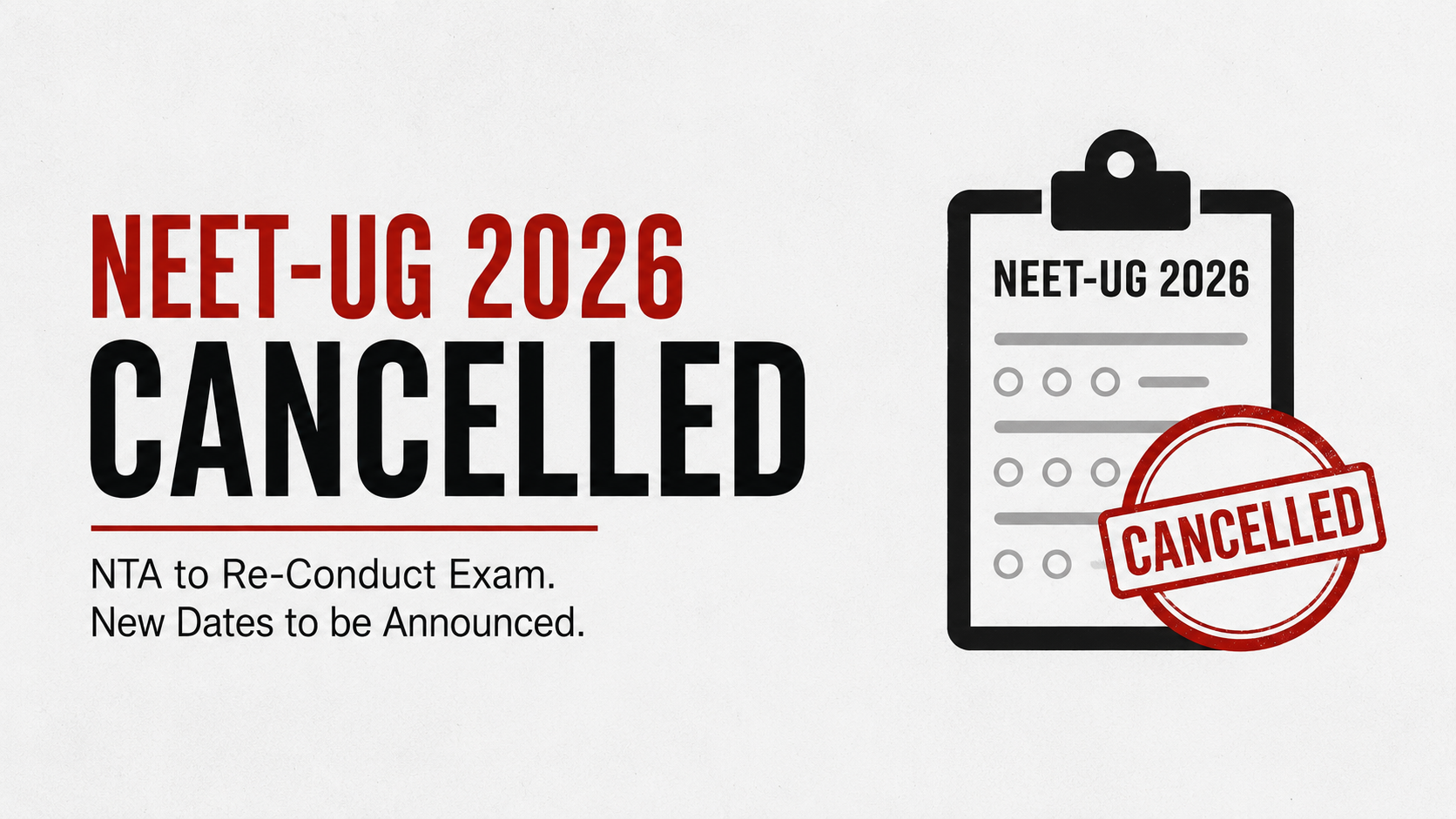
In one of the most dramatic decisions in the history of Indian competitive examinations, the National Testing Agency (NTA), with the approval of the Government of India, has officially cancelled the NEET-UG 2026 examination conducted on May 3, 2026.
The government has also ordered a CBI investigation into the allegations surrounding the exam, while fresh dates for the re-examination will be announced separately. The decision has triggered nationwide outrage, panic among students, and renewed scrutiny of India’s examination system.
For lakhs of aspirants, NEET is not merely an entrance examination. It is the gateway to becoming a doctor, a career many students spend years preparing for under enormous academic and emotional pressure. The cancellation of the exam therefore represents far more than an administrative failure — it has become a national crisis involving trust, institutional credibility, and the future of India’s competitive examination system.
What Led to the Cancellation of NEET-UG 2026?
The controversy surrounding NEET-UG 2026 began shortly after the examination concluded on May 3. Reports started surfacing online about a suspicious “guess paper” allegedly circulating before the exam. Students and coaching communities claimed that several questions appearing in these materials closely matched the actual question paper.
Initially, many dismissed the allegations as routine post-exam speculation. However, as more evidence emerged, the issue quickly escalated.
Investigators reportedly discovered that over 100 questions in the circulated material allegedly matched the final examination paper. The leak trail eventually pointed toward networks operating in Rajasthan and Uttarakhand, raising fears that organized paper leak rackets may have compromised one of India’s most important examinations.
As pressure mounted, central agencies began reviewing evidence submitted by state authorities and law enforcement agencies. Within days, the situation became serious enough for the Government of India to intervene directly.
The NTA eventually announced that the integrity of the examination had been compromised and therefore the exam could no longer be considered fair or credible.
Why This Controversy Is So Massive
The scale of the crisis cannot be understood without understanding what NEET represents in India.
Every year, more than 24 lakh students appear for NEET-UG, making it one of the largest and most competitive entrance examinations in the world. For many families, especially middle-class and lower-income households, success in NEET is viewed as a life-changing opportunity.
Students often spend:
- years in coaching institutes,
- massive amounts of family savings,
- and nearly their entire teenage lives preparing for this single examination.
In such a system, even the suspicion of unfairness becomes explosive.
The cancellation of the examination now means lakhs of students must once again enter months of uncertainty, stress, and preparation. Many aspirants had already exhausted themselves mentally preparing for the May examination. Now they are being forced to restart the process from the beginning.
NEET 2026 Cancelled: The Growing Anger Against the NTA
The National Testing Agency was originally created to modernize India’s entrance examination system and reduce irregularities through centralized professional management.
However, over the last few years, the NTA has repeatedly faced criticism over:
- technical glitches,
- server failures,
- administrative confusion,
- and questions regarding examination integrity.
The NEET-UG 2026 controversy has intensified demands for accountability.
Critics argue that despite repeated warnings and previous controversies involving national examinations, the agency failed to create a truly secure system capable of preventing organized leaks.
For many students, this controversy feels less like an isolated incident and more like the latest example of systemic failure.
The Rajasthan Leak Network Under Investigation
One of the most explosive aspects of the case is the alleged Rajasthan connection.
Investigators are reportedly examining whether organized criminal groups and paper leak networks played a role in circulating exam-related material before the test.
Authorities are also investigating whether:
- insiders,
- coaching-linked intermediaries,
- or digital communication networks
were involved in distributing confidential examination content.
The investigation has now expanded beyond a simple paper leak inquiry and may become one of India’s largest examination fraud probes in recent years.
Several reports suggest investigators are analyzing:
- WhatsApp groups,
- Telegram channels,
- financial transactions,
- and communication records
to determine how leaked material circulated before the examination.
Why the Government Ordered a CBI Investigation
The decision to transfer the matter to the Central Bureau of Investigation indicates the seriousness of the allegations.
The government appears to believe that the issue may involve interstate organized networks rather than isolated local cheating incidents.
The CBI is expected to investigate:
- the source of the leak,
- possible institutional failures,
- digital circulation channels,
- and the role of any organized rackets.
The involvement of central investigative agencies also reflects growing political pressure surrounding the controversy.
The government now faces a major credibility challenge because repeated paper leak scandals across India have already weakened public trust in competitive examinations.
India’s Coaching Industry Under Scrutiny Again
The NEET controversy has once again brought attention to India’s enormous coaching ecosystem.
The country’s medical and engineering coaching industry is worth thousands of crores and exerts enormous influence over competitive examination culture.
Many institutes market:
- “most expected questions,”
- “sure-shot predictions,”
- and “exclusive paper pattern analysis.”
While much of this is simply aggressive marketing, investigators are now examining whether some networks had access to illegally obtained examination information.
The blurred line between prediction culture and organized leakage has become one of the most controversial aspects of the current investigation.
Students Face Emotional and Psychological Trauma
Perhaps the most devastating impact of the cancellation is psychological.
For students preparing for NEET, life often revolves entirely around the examination. Many aspirants study for:
- 10 to 14 hours daily,
- sacrifice social life,
- and face extreme family expectations.
The sudden cancellation has therefore triggered:
- anxiety,
- emotional exhaustion,
- frustration,
- and anger.
Social media platforms quickly filled with reactions from students questioning whether merit still matters in India’s examination system.
Many students pointed out that they had already spent years preparing and now faced the prospect of repeating the process again under even greater mental pressure.
Parents have also expressed outrage over the uncertainty and repeated failures surrounding national examinations.
A Larger Crisis of Institutional Trust
The biggest damage caused by the NEET controversy may ultimately be the erosion of trust.
India’s examination system functions because students believe that despite intense competition, the process remains fundamentally fair.
That trust is now weakening.
Repeated scandals involving:
- paper leaks,
- recruitment fraud,
- examination irregularities,
- and administrative failures
have created a growing perception that organized networks can manipulate high-stakes examinations.
Even students who perform honestly increasingly fear that the system itself may not protect merit.
Political Reactions Intensify
The cancellation has also become a major political issue.
Opposition parties have accused the government of failing to reform the examination system despite repeated controversies in recent years.
Several opposition leaders described the cancellation as:
- a governance failure,
- an institutional collapse,
- and a betrayal of students.
Meanwhile, the government has defended its decision, arguing that cancelling the examination was necessary to protect fairness and prevent compromised results from affecting honest candidates.
The controversy is likely to remain politically sensitive because NEET directly affects millions of families across India.
Can India’s Exam System Be Rebuilt?
Experts argue that India’s examination infrastructure requires urgent modernization.
Many believe future reforms must include:
- stronger digital encryption,
- secure paper distribution systems,
- biometric verification,
- AI-based monitoring,
- and stricter accountability mechanisms.
However, technology alone may not solve the deeper institutional problems.
The current crisis has exposed weaknesses involving:
- human handling systems,
- coordination failures,
- and lack of accountability.
Without structural reforms, many fear similar controversies could happen again.
What Happens Next?
The NTA has confirmed that NEET-UG 2026 will be conducted again on dates that will be announced separately.
Students are now waiting for clarity regarding:
- revised examination schedules,
- counselling timelines,
- and admission processes.
The delay is expected to affect:
- medical college admissions,
- academic calendars,
- and state-level counselling systems across India.
Meanwhile, the CBI investigation is likely to continue for months as authorities attempt to determine how one of India’s most important examinations was compromised.
Conclusion
The cancellation of NEET-UG 2026 is not just an educational controversy. It is a national institutional crisis.
For lakhs of students, it represents emotional exhaustion and renewed uncertainty after years of preparation.
For the National Testing Agency, it has become the biggest credibility challenge in its history.
And for the Government of India, the controversy has raised uncomfortable questions about whether the country’s competitive examination system is still capable of guaranteeing fairness in an era of organized digital leaks and expanding coaching networks.
The coming months will determine not only how the re-examination is conducted, but also whether students can once again trust the system that decides their future.