
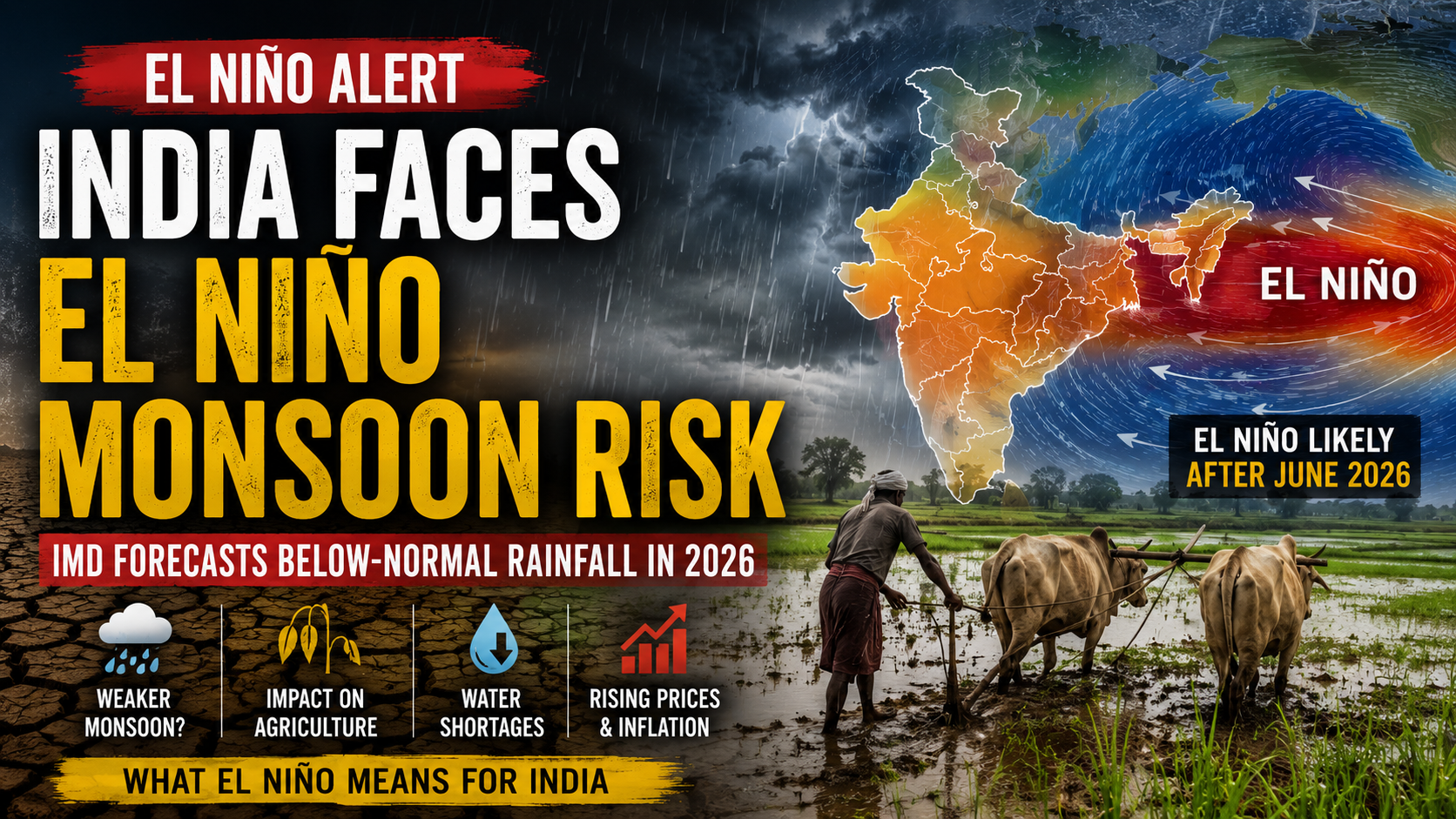
India may be heading toward one of its most challenging monsoon seasons in recent years as weather agencies and climate experts warn about the growing possibility of El Niño conditions developing during the second half of 2026.
The India Meteorological Department (IMD) has already forecast below-normal monsoon rainfall for the first time in three years, raising concerns about agriculture, inflation, food prices, water shortages, and overall economic growth.
Although the monsoon is expected to arrive early over Kerala this year, experts say that does not necessarily guarantee strong seasonal rainfall across the country.
The real concern lies in the Pacific Ocean, where warming sea temperatures are increasingly pointing toward the possible return of El Niño.
India El Niño Monsoon Risk: What Is El Niño?
El Niño is a climate phenomenon caused by unusually warm ocean temperatures in the central and eastern Pacific Ocean.
These temperature shifts affect atmospheric circulation across the world and often disrupt normal weather patterns.
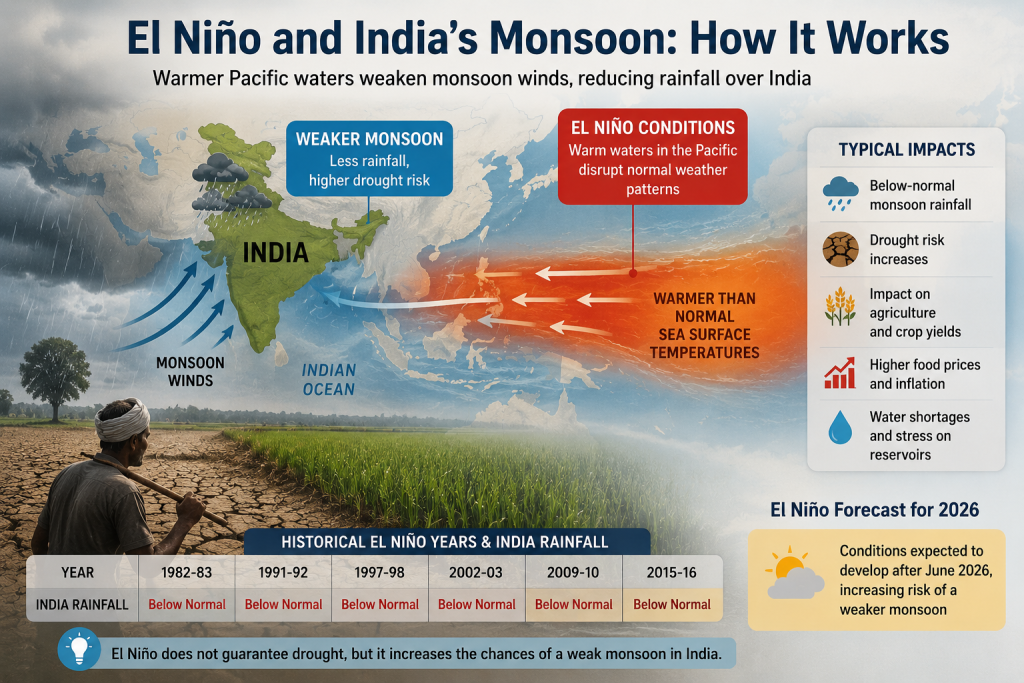
For India, El Niño has historically been associated with:
- weaker monsoon rainfall,
- higher temperatures,
- drought conditions,
- crop damage,
- and rising food inflation.
Not every El Niño year results in drought, but the relationship between El Niño and weaker Indian monsoons is well established.
According to Reuters, India experienced below-average rainfall during most major El Niño years over the last several decades.
Why India’s Monsoon Matters So Much
The Indian monsoon is not just a weather event — it is the backbone of the country’s economy.
Nearly 70% of India’s annual rainfall comes during the June-to-September southwest monsoon season.
The monsoon directly impacts:
- farming,
- groundwater,
- reservoirs,
- electricity production,
- food prices,
- and rural incomes.
India’s agriculture sector still employs a massive portion of the population and contributes significantly to the economy. Weak rainfall can therefore trigger ripple effects across multiple sectors.
Even urban India eventually feels the impact through:
- rising vegetable prices,
- electricity shortages,
- water scarcity,
- and inflation.
IMD Predicts Below-Normal Rainfall
In April 2026, the IMD forecast that India would likely receive only 92% of its long-period average monsoon rainfall — the lowest forecast in nearly three decades.
The IMD defines “normal rainfall” as:
- between 96% and 104%
of the historical average.
A forecast of 92% officially falls into the “below normal” category.
According to IMD Director General Mrutyunjay Mohapatra, current weak La Niña-like conditions are expected to transition toward neutral conditions before a likely El Niño develops after June.
That timing is important because the second half of the monsoon season is critical for:
- crop development,
- reservoir replenishment,
- and overall seasonal rainfall totals.
Why Experts Are Worried About 2026
Climate scientists are increasingly concerned because weather models suggest the 2026 El Niño could become particularly strong.
The World Meteorological Organization (WMO) has also flagged the growing likelihood of El Niño conditions returning between May and July 2026.
Some international models have even raised concerns about the possibility of a “super El Niño,” similar to the powerful events seen in:
- 1982–83,
- 1997–98,
- and 2015–16.
Strong El Niño events can dramatically reshape global weather patterns.
For India, that often means:
- weaker monsoon winds,
- reduced rainfall,
- prolonged heatwaves,
- and increased drought risk.
Early Monsoon Arrival May Not Mean Good Rainfall
Interestingly, the IMD recently predicted that the monsoon could arrive over Kerala around May 26 — earlier than usual.
Normally, the monsoon reaches Kerala around June 1.
An early onset often creates optimism among farmers because it allows earlier sowing of crops like:
- rice,
- soybean,
- sugarcane,
- and maize.
However, weather experts caution that:
an early monsoon onset does not guarantee a strong or evenly distributed monsoon season.
India has experienced years where the monsoon arrived early but weakened significantly later.
That is exactly why the developing El Niño remains the bigger concern.
India El Niño Monsoon Risk: Impact on Agriculture
Agriculture is likely to face the biggest risk if rainfall weakens substantially. Lower rainfall could reduce the production of:
- rice,
- wheat,
- pulses,
- cotton,
- soybeans,
- and sugarcane.
The consequences could include:
- lower farmer incomes,
- rising food prices,
- increased edible oil imports,
- and restrictions on food exports.
India previously imposed export restrictions on certain crops during weak monsoon years to protect the domestic supply.
Reuters reported that concerns over weaker rainfall have already influenced decisions around sugar exports due to fears about future sugarcane production.
According to: The News Minute
Inflation Could Rise Again
One of the biggest fears surrounding a weak monsoon is inflation.
Food accounts for nearly one-third of India’s consumer price index.
Poor rainfall often leads to:
- lower crop yields,
- supply shortages,
- and rising food costs.
Economists have warned that inflation could rise significantly if the monsoon underperforms while global commodity prices also remain elevated because of geopolitical tensions.
This could put pressure on:
- the Reserve Bank of India,
- interest rates,
- consumer spending,
- and overall economic growth.
India El Niño Monsoon Risk: Water and Power Concerns
A weaker monsoon would not only affect farming.
India’s:
- reservoirs,
- rivers,
- groundwater systems,
- and hydropower generation
also depend heavily on seasonal rainfall.
Reduced rainfall can lower hydropower production and increase dependence on coal-based electricity generation.
Several Indian cities already face recurring water shortages during summer months, and weak monsoon rains could intensify those problems.
Heatwaves May Become Worse
India has already experienced intense heatwaves during 2026.
El Niño conditions are often linked to:
- hotter temperatures,
- extended dry spells,
- and more severe heat events.
Climate scientists say that global warming may also amplify the effects of future El Niño events.
Some researchers believe a strong El Niño during 2026–27 could contribute to record global temperatures.
Scientists Still Warn Against Panic
Despite the concerns, scientists also caution against assuming disaster is inevitable.
India has occasionally received normal rainfall even during El Niño years. Reuters noted that at least 5 out of 17 El Niño events over the last seven decades still produced average or above-average monsoon rainfall in India.
Another important factor is the Indian Ocean Dipole (IOD).
Meteorologists believe positive IOD conditions later in the season could partially offset some El Niño impacts and support rainfall.
Modern forecasting technology has also improved significantly.
The IMD recently launched AI-powered forecasting systems capable of providing localized monsoon predictions weeks in advance.
Political and Economic Implications
Weak monsoons have historically created political pressure in India because rising food prices directly affect millions of households.
Economic experts warn that:
- inflation,
- rural distress,
- and slower growth
could become major concerns if rainfall remains significantly below normal.
With several important state elections approaching in the coming year, weather conditions may indirectly shape political narratives as well.
India El Niño Monsoon Risk: Final Outlook
At the moment, India is entering the 2026 monsoon season under growing uncertainty.
An early monsoon onset has created initial optimism, but the rising probability of El Niño has overshadowed that excitement.
If El Niño strengthens during the second half of the monsoon season, India could face:
- weaker rainfall,
- rising inflation,
- agricultural stress,
- and intensified heatwaves.
However, weather experts stress that climate forecasting remains complex, and the final monsoon outcome will depend on how multiple oceanic and atmospheric systems evolve over the next few months.
For now, India’s farmers, policymakers, and economists will be watching the Pacific Ocean very closely.