The Pentagon has abruptly canceled a planned deployment of thousands of American troops to Poland, triggering fresh debate over the future of the United States military presence in Europe under Defense Secretary Pete Hegseth and President Donald Trump.
The canceled deployment involved approximately 4,000 troops from the U.S. Army’s 2nd Armored Brigade Combat Team, part of the 1st Cavalry Division based in Texas. The troops had been scheduled for a rotational deployment to Poland as part of NATO’s eastern flank presence.
The sudden decision has raised concerns among European allies and lawmakers in Washington, especially because the move comes shortly after the Pentagon announced plans to withdraw 5,000 U.S. troops from Germany.
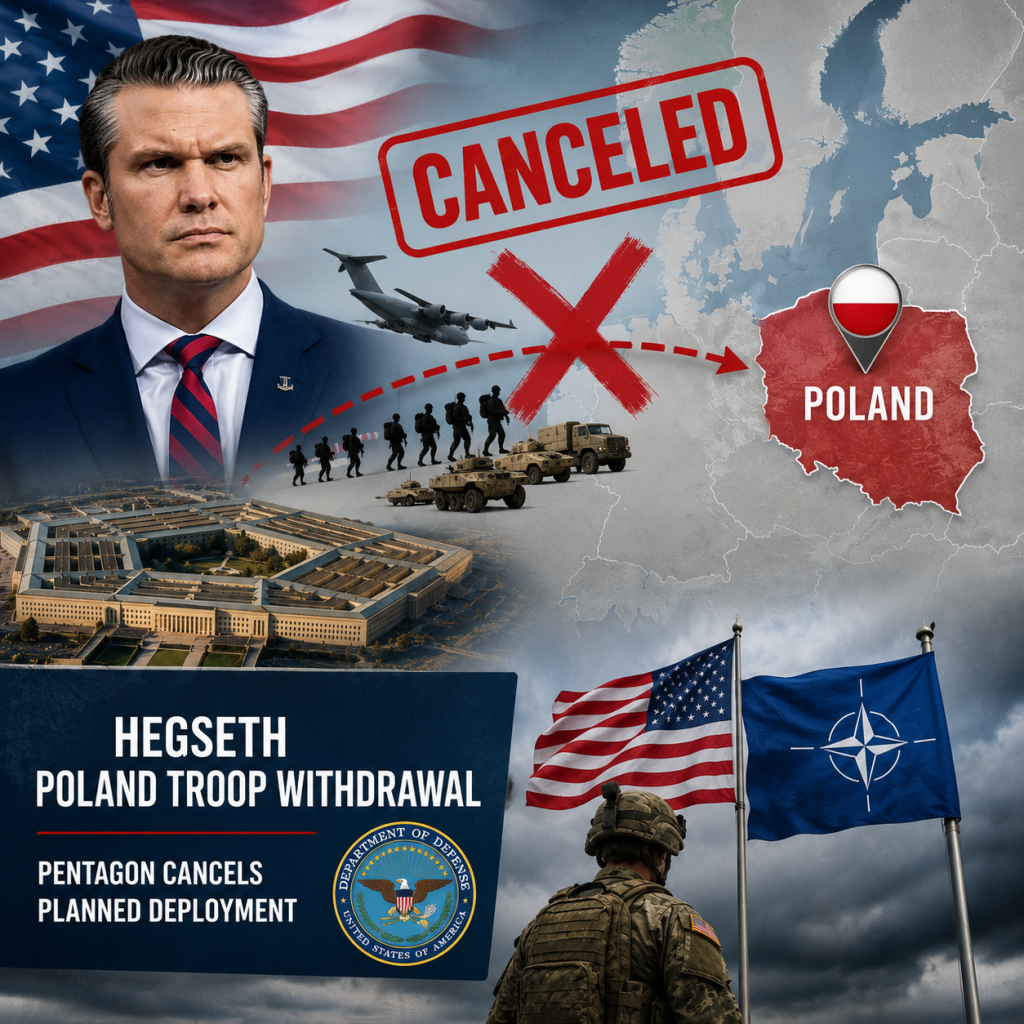
Why the Pentagon Canceled the Poland Deployment
According to Reuters and The Wall Street Journal, the Pentagon has not publicly provided a detailed explanation for the cancellation. However, officials indicated the move is part of a broader restructuring of America’s military posture in Europe.
The deployment had already partially begun, with some troops and equipment reportedly preparing for movement before the order was halted.
Defense officials told U.S. media that the cancellation aligns with the Trump administration’s larger strategy of:
- reducing long-term American troop commitments in Europe,
- pushing NATO allies to take greater responsibility for their own defense,
- and shifting U.S. strategic focus toward the Indo-Pacific region.
The Pentagon’s latest National Defense Strategy reportedly emphasizes limiting America’s direct conventional military burden in Europe while encouraging European allies to strengthen their own forces.
Hegseth Poland Troop Withdrawal: Pete Hegseth’s Role in the Decision
Defense Secretary Pete Hegseth has emerged as one of the key figures behind the administration’s military restructuring plans.
Reports from U.S. media suggest Hegseth accelerated troop reduction efforts more aggressively than some military officials had expected.
The Wall Street Journal reported that several Pentagon and Army officials were surprised by how quickly the Poland deployment was halted, especially since the brigade rotation had already been prepared operationally.
Hegseth, a former Fox News host and military veteran, has repeatedly argued that NATO allies have become too dependent on American military protection.
Under the current administration, Washington has increasingly pressured European countries to:
- raise defense spending,
- modernize their militaries,
- and assume greater responsibility for conventional deterrence against Russia.
Why Poland Matters So Much to NATO
Poland has become one of NATO’s most strategically important countries since Russia’s invasion of Ukraine in 2022.
Located on NATO’s eastern flank, Poland serves as:
- a logistical hub,
- a transit corridor for military aid,
- and a major staging area for allied forces near Russia and Belarus.
Over the last several years, the U.S. significantly increased troop deployments across Eastern Europe, especially in Poland, Romania, and the Baltic region.
The canceled deployment was supposed to reinforce NATO’s eastern deterrence posture.
That is why the decision immediately sparked questions about whether Washington is preparing for deeper troop cuts across Europe.
Poland Responds to the Pentagon Decision
Polish Prime Minister Donald Tusk attempted to calm concerns after reports of the cancellation emerged.
Tusk said he had received assurances from American officials that Poland’s security and NATO deterrence capabilities would not be directly affected by the decision.
Polish Defense Minister Władysław Kosiniak-Kamysz also stated that the move was part of broader logistical adjustments and did not specifically target Poland.
Despite those reassurances, the decision has still generated anxiety among some European analysts who fear the United States may gradually scale back its military footprint on the continent.
Connection to Germany Troop Withdrawals
The Poland deployment cancellation came only weeks after the Pentagon announced plans to remove around 5,000 U.S. troops from Germany.
Germany currently hosts roughly 35,000 American military personnel and remains one of the most important U.S. military hubs outside America itself.
Some officials reportedly suggested the Poland cancellation may help facilitate the broader Germany drawdown strategy.
The Trump administration has repeatedly criticized European allies — particularly Germany — over defense spending levels and disagreements surrounding U.S. foreign policy decisions.
Hegseth Poland Troop Withdrawal: Growing Rift Between the US and Europe
The troop reduction debate is unfolding during increasing tensions between Washington and several European governments.
Reuters reported that President Trump has been frustrated by Europe’s response to recent U.S. military actions involving Iran.
The administration has also accused some NATO allies of relying excessively on American military protection while underinvesting in their own defense systems.
At the same time, European leaders remain deeply concerned about Russia’s long-term military threat following the war in Ukraine.
This has created uncertainty about the future shape of transatlantic security cooperation.
Concerns Inside the United States
The sudden nature of the Pentagon’s decision has also reportedly alarmed some lawmakers in Washington.
Reuters reported that members of Congress were not formally notified before the Poland deployment cancellation became public.
That is significant because Congress previously passed legislation designed to prevent future administrations from dramatically reducing U.S. troop levels in Europe without proper consultation and security assessments.
Under the 2023 National Defense Authorization Act (NDAA), troop levels in Europe are not supposed to fall below 76,000 unless the administration certifies that:
- NATO allies have been consulted,
- and the reductions would not undermine deterrence or U.S. national security.
NATO Says Eastern Flank Will Remain Strong
Despite concerns, NATO officials insist that alliance defense plans remain intact.
A senior NATO military official told Reuters that rotational deployments like the canceled Poland mission are not central to NATO’s core deterrence strategy.
The alliance emphasized that NATO would continue maintaining a strong military presence on its eastern flank, including:
- German forces,
- Canadian troops,
- and multinational NATO deployments across Eastern Europe.
However, analysts note that symbolism matters heavily in geopolitics.
Reducing visible American troop movements in Eastern Europe could still be interpreted by adversaries as a sign of weakening U.S. commitment.
Hegseth Poland Troop Withdrawal: Critics Fear a Strategic Mistake
Critics of the troop cuts argue that reducing American military presence in Europe at a time of heightened global instability may embolden Russia.
Some analysts also fear that sudden and unpredictable military decisions could create uncertainty among allies already concerned about America’s long-term commitment to NATO.
The troop withdrawal debate has become part of a larger conversation about:
- America’s global military priorities,
- the future of NATO,
- and whether Washington should continue acting as Europe’s primary security guarantor.
What Happens Next?
The Pentagon has not yet released a full roadmap for future troop levels across Europe.
However, reports suggest additional reductions or restructuring decisions may still be coming.
At present, the cancellation of the Poland deployment appears to signal a broader shift in U.S. defense strategy rather than an isolated logistical adjustment.
The coming months may reveal whether the United States is preparing for:
- a limited rebalancing of forces,
- or a much larger transformation of America’s military role in Europe.
For NATO allies watching Russia closely, that distinction could prove extremely important.