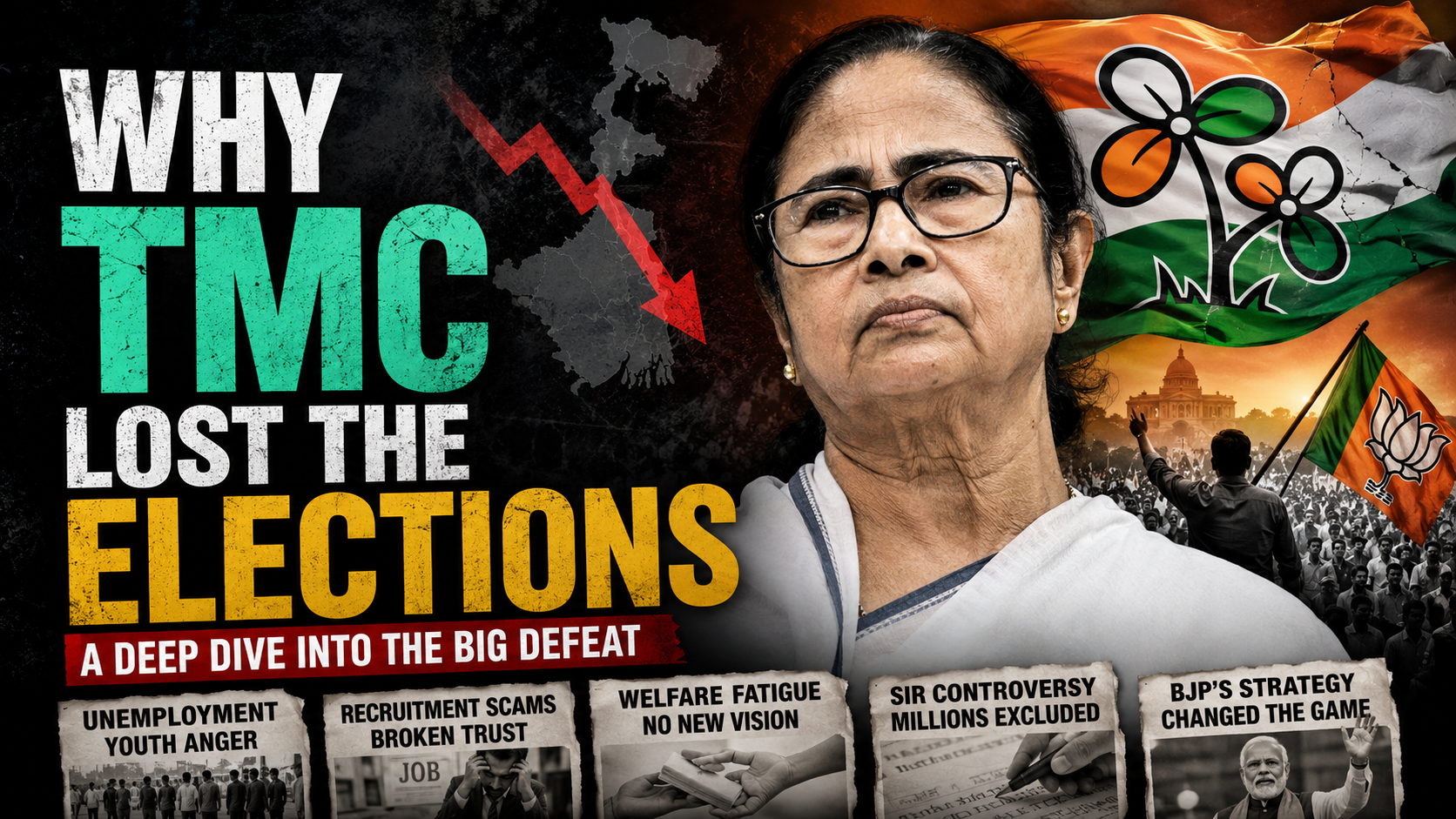
In 2011, Mamata Banerjee took oath as the Chief Minister of West Bengal, ending the 34-year rule of the Left Front and completely reshaping Bengal politics. Over the next 15 years, the Trinamool Congress (TMC) established itself as the dominant political force in the state.
But in 2026, the political landscape changed dramatically.
The Bharatiya Janata Party (BJP) not only defeated the TMC decisively but also formed the government with a massive majority. Even more significantly, Mamata Banerjee herself lost her own constituency — a symbolic moment that reflected the scale of the political shift in Bengal.
But what caused this sudden anti-TMC wave in West Bengal? Why did the massive mandate of 2021 collapse within just 5 years?
While the TMC has blamed the Special Intensive Revision (SIR) process and the Election Commission, BJP supporters argue that corruption, unemployment, anti-incumbency, and appeasement politics pushed voters away from the ruling party.
Political analysts, meanwhile, believe the defeat was caused by a combination of administrative fatigue, organizational anger at the grassroots level, welfare politics losing effectiveness, and the BJP’s highly strategic campaign machinery. This article attempts to examine the reasons behind TMC’s defeat from multiple perspectives.
The SIR Controversy and Missing Voter Names
Long before the elections, Mamata Banerjee repeatedly claimed that although the SIR process was being conducted in Bihar ahead of elections there, the BJP’s real target was West Bengal.
The rushed nature of the SIR exercise was criticized by intellectuals and civil society voices across India. In Bengal, a significant number of voter names were reportedly excluded during the revision process.
Why the SIR Became Politically Explosive
Although SIR processes were conducted in multiple states, TMC leaders pointed out that only in Bengal did the Election Commission publish a separate “logical discrepancy” list, which became a major political issue.
Eventually, after the final SIR list was released, many names were restored. However, more than 9.1 million voter names reportedly remained excluded.
According to available estimates:
- around 5.8 million of those voters were either deceased or relocated,
- but a substantial number remained under adjudication or unresolved.
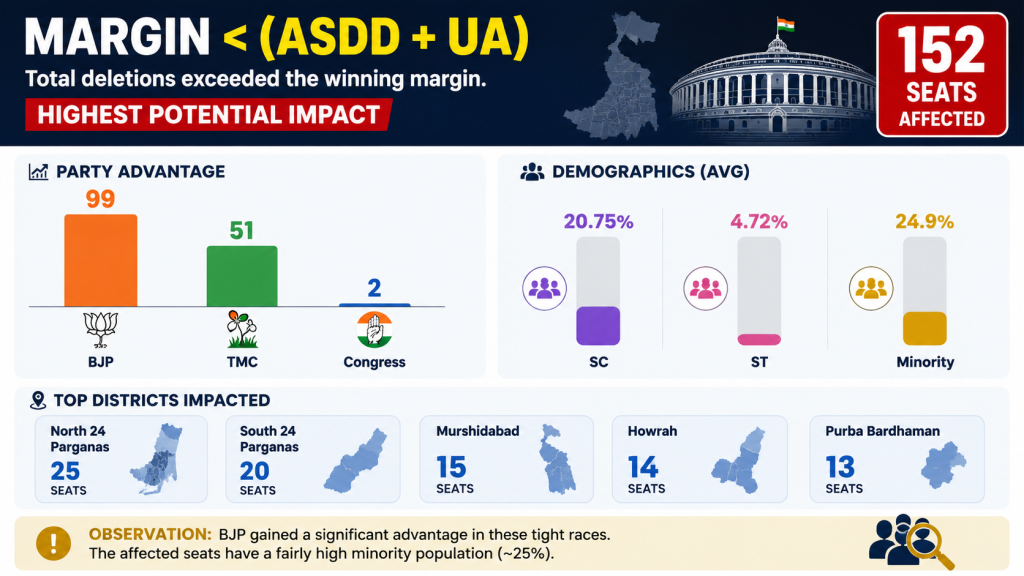
Seats Where the Margin Was Smaller Than Excluded Voters
TMC leaders repeatedly highlighted that in many constituencies, the BJP’s victory margin was lower than the number of excluded or disputed voters.
Example: Satgachia Assembly Seat
In Satgachia:
- BJP reportedly won by just 401 votes,
- while 8,785 voter names remained under adjudication.
Similar situations were reportedly seen in: Rayna, Rajarhat-New Town, and several other constituencies.
This led to a major political question: If all disputed voters had been reinstated before the election, would the BJP still have secured a two-thirds majority so comfortably?
Despite these arguments, overall statistics suggest the BJP benefited more from the final voter list changes than the TMC.
Why TMC Lost Bengal: BJP’s Massive Organizational Push in Bengal
The BJP has historically relied heavily on central leaders during Bengal elections.
As in previous elections, leaders such as: Narendra Modi, Amit Shah, Yogi Adityanath, Himanta Biswa Sarma, and other BJP chief ministers actively campaigned across Bengal.
However, the BJP introduced a new strategy in 2026.
Strengthening Booth-Level Organization
Instead of relying only on rallies and speeches, the BJP focused heavily on strengthening its grassroots organization.
According to political sources:
- BJP National General Secretary Sunil Bansal played a major role in organizational planning,
- nearly 15,000 trained workers reportedly worked on booth management and local coordination,
- and many organizers came from states like Uttar Pradesh, Rajasthan, and Chhattisgarh.
Leaders such as: Biplab Kumar Deb, Amit Malviya, and Dharmendra Pradhan were also reportedly involved in Bengal’s election management.
Targeting Select Constituencies
Analysts believe the BJP carefully identified constituencies where anti-incumbency was strongest and concentrated organizational energy there.
Instead of using “outsider leaders” only for public campaigning, the BJP used many of them for:
- booth-level management,
- voter outreach,
- and local organizational strengthening.
Many political observers believe this strategy proved highly effective.
Anti-Incumbency Against 15 Years of TMC Rule
Although the TMC blamed the Election Commission and SIR process, it would be difficult to argue that Bengal’s political mood remained strongly in favor of the ruling party.
After 15 years in power, public dissatisfaction had gradually increased.
Key Complaints Against the TMC Government
Opposition parties repeatedly raised issues such as:
- unemployment,
- corruption in recruitment,
- extortion allegations,
- local-level political syndicates,
- and nepotism.
Even though these allegations existed for years, TMC continued to receive massive public support in previous elections.
The Mamata Factor
Despite anger against many local TMC leaders, Mamata Banerjee’s personal political image remained extremely strong for a long time.
Her long political struggle against the Left Front and her welfare-oriented governance style convinced many voters to continue supporting TMC.
After ending the 34-year Left rule, Mamata Banerjee introduced several mass welfare schemes that helped the party secure three consecutive victories.
But over time, accumulated public frustration became harder to contain.
SSC and TET Recruitment Corruption Cases
One of the most damaging issues for the TMC government was the recruitment corruption controversy.
Why the Recruitment Scam Hurt TMC So Deeply
Recruitment exams like:
- SSC,
- Primary TET,
- and other government hiring processes
affect lakhs of educated Bengali youth. Due to corruption allegations and court interventions:
- many qualified candidates lost jobs,
- recruitment processes stalled,
- and legal uncertainty continued for years.
This created a widespread perception that restoring transparency in employment required political change.
For many young voters and middle-class families, the issue became emotional rather than purely political.
Welfare Fatigue and Lack of New Vision
From 2011 onward, TMC introduced several major welfare projects such as:
- Kanyashree,
- Sabooj Sathi,
- Duare Sarkar,
- and multiple social welfare schemes.
Several of these projects received international recognition and significantly benefited poor and marginalized communities.
However, after 2021, critics argued that the government failed to introduce similarly transformative new schemes.
Dependence on Allowance-Based Politics
Instead, TMC increasingly focused its campaign around:
- Lakshmir Bhandar,
- Yuva Sathi,
- and other allowance-based welfare schemes.
While these schemes remained popular, some analysts believe voters began expecting:
- job creation,
- industrial growth,
- and long-term economic opportunities
rather than only financial assistance.
BJP’s Sankalp Patra Changed the Narrative
One of the BJP’s biggest strengths in 2026 was its highly aggressive and modern manifesto strategy.
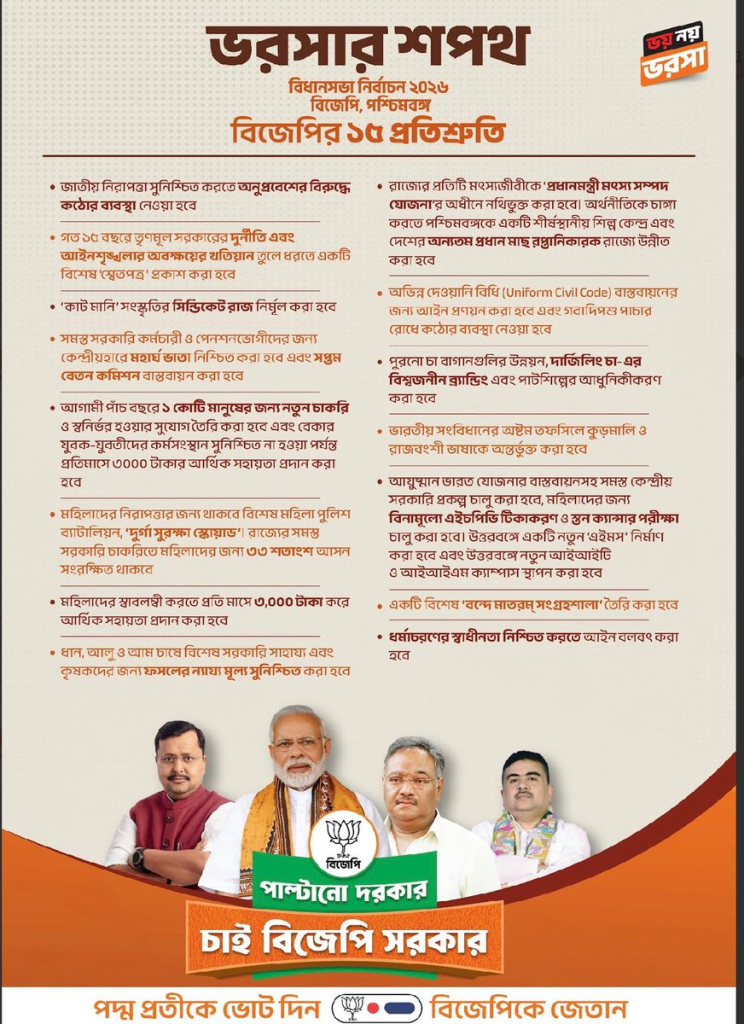
BJP’s Welfare Counterattack
The BJP promised:
- expansion of central schemes,
- housing benefits,
- employment support,
- and direct financial assistance.
Annapurna Bhandar
One of the most discussed promises was “Annapurna Bhandar.”
The BJP promised to increase women’s monthly financial support from: ₹1,500–₹1,700 under TMC schemes to ₹3,000 per month. Many analysts believe this announcement significantly affected TMC’s female voter base.
Doubling Youth Allowances
The BJP also promised increased financial support under youth-focused schemes, directly targeting unemployed young voters.
Constituency-Wise Manifestos
Another major innovation was BJP’s assembly constituency-specific Sankalp Patra strategy.
Instead of only releasing a statewide manifesto, the BJP prepared localized promises for individual constituencies, explaining:
- what each region would gain,
- what infrastructure would improve,
- and what benefits residents could expect under BJP rule.
Political observers believe this strategy created strong local engagement.
The Return of “Poriborton” Politics
Throughout the campaign, BJP leaders repeatedly emphasized the idea of “Poriborton” — political change.
Ironically, this was the same emotional slogan Mamata Banerjee herself used successfully in 2011 against the Left Front government.
BJP Reused the Politics of Change
Prime Minister Narendra Modi and BJP campaigners repeatedly framed the election as:
- a fight against stagnation,
- corruption,
- and political fatigue.
The BJP successfully projected itself as the new force of change in Bengal politics.
TMC’s “Outsider” Narrative Lost Effectiveness
In 2021, TMC successfully used slogans such as:
“Bangla Nijer Meyekei Chay”
to frame the BJP as an “outsider party.”
Even in the 2024 Lok Sabha elections, TMC used Bengali identity politics effectively.
However, this strategy appeared less effective in 2026.
BJP’s Bengali Cultural Shift
The BJP made a conscious effort to embrace Bengali cultural identity.
Campaign visuals increasingly featured:
- dhoti-panjabi attire,
- Bengali symbolism,
- local religious imagery,
- and Bengali cultural messaging.
Even slogans evolved.
Alongside “Jai Shri Ram,” BJP campaigners also prominently used:
- “Jai Maa Kali”
- and “Jai Maa Tara.”
Many observers believe this helped soften the BJP’s earlier “outsider” image among sections of Bengali voters.
Religious Polarization and Muslim Vote Division
Religious polarization also played a major role in the election.
Impact of the Waqf Bill Debate
Issues like the Waqf Bill created divisions within sections of the Muslim voter base.
In Muslim-majority districts such as Murshidabad, where TMC had previously dominated, alternative forces began emerging.
These included:
- Congress,
- Left Front candidates,
- and smaller regional parties.
Rise of Smaller Muslim Political Forces
One notable example was Humayun Kabir’s:
“Aam Janata Unnayan Party”
which reportedly won 2 seats.
Analysts believe these smaller parties cut into TMC’s Muslim vote share, indirectly benefiting the BJP.
Muslim Voter Exclusion Debate
According to political estimates:
- 34% of excluded SIR names were Muslims,
- many of whom were likely TMC supporters.
This became one of TMC’s strongest post-election arguments.
Local-Level Anger Against TMC Leadership
Although Mamata Banerjee herself largely avoided major personal corruption allegations, anger against local TMC leaders remained intense in several districts.
Panchayat Violence and Political Fatigue
Violence during previous Panchayat elections had damaged TMC’s image significantly.
In contrast, the heavy deployment of central forces during the 2026 Assembly election ensured relatively peaceful voting in many areas.
For the first time in Bengal’s electoral history, the election was conducted without large-scale politically linked deaths.
This created confidence among voters who previously feared political intimidation.
BJP’s Final Victory
Whatever the reasons behind the result, the outcome was historic.
The BJP formed the government with:
- 207 seats,
while - the TMC was reduced to just 80 seats.
Political analysts believe the TMC’s biggest challenge now is not simply returning to power — but preserving its long-term political existence as Bengal’s primary opposition force.
TMC’s Counterargument After Defeat
Even after the defeat, the TMC has continued accusing the BJP of using:
- central agencies,
- the Election Commission,
- and administrative machinery
to weaken opposition parties politically.
Mamata Banerjee has also called for greater unity among anti-BJP parties nationally.
At the same time, the TMC leadership has highlighted alleged incidents of post-election violence against party workers across different parts of Bengal.
Conclusion
The 2026 West Bengal Assembly election was not decided by a single issue.
TMC’s defeat was shaped by:
- anti-incumbency,
- corruption allegations,
- recruitment controversies,
- welfare fatigue,
- Muslim vote fragmentation,
- BJP’s organizational expansion,
- and changing political psychology among Bengali voters.
At the same time, the TMC continues to argue that the role of the Election Commission and SIR process cannot be ignored.
Whether this election marks a permanent political transformation in Bengal or simply another phase in the state’s highly volatile political history remains to be seen.